



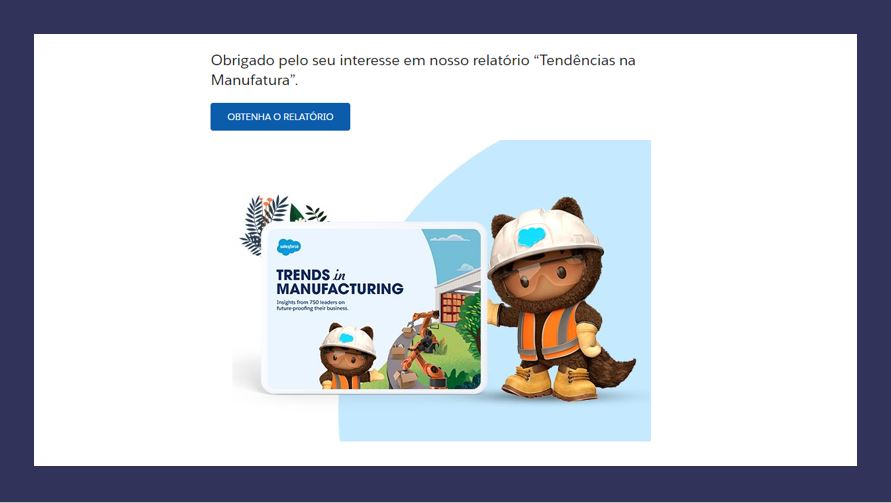
Salesforce, a global company in customer relationship management (CRM) solutions, released its report Trends in Manufacturing, which shows the far-reaching effects that the global pandemic has had on the industrial sector. Salesforce's recent data analysis highlights how companies have had to adopt new strategies and models, gaps in achieving transformation, and how the use of new technologies has helped prepare them to compete in response to ongoing uncertainty.
“The deep quarter-to-quarter changes in our clients' results create room for more fundamental changes in business models,” comments Fabio Costa, Salesforce's general manager in Brazil.
Salesforce Research interviewed nearly 750 global manufacturing leaders in North America, Latin America, Asia-Pacific and Europe, including interviewees of Brazil. Specifically, the two groups surveyed were future-proof manufacturers – those who thought their systems and technology could handle the next decade; and unprepared manufacturers – those who didn't think their systems could handle the next ten years. The main differences between respondents were identified and the following themes were revealed:
- Uncertainty has brought an urgent need for business agility as well as an opportunity to re-imagine certain functions;
- Functions adjacent to the client were permanently altered by the pandemic;
- Digitized sales and operations are essential for an agile, future-ready business;
- New business models such as servitization (services as a product) are an important part of forward-looking manufacturers' strategy.
The main insights from local respondents in Brazil are presented below:
Adapting to a post-pandemic world
The impact of COVID-19 on manufacturers has been far-reaching and has not only changed the way they do business now, it will leave a lasting impression on how they will operate in the future. 76% of respondents in Brazil reported that their production capacity was significantly or slightly altered as a result of the pandemic – with others 46% believing that the changes will be permanent.
Differentiated products and services
Given the significant disruption caused to the industry during the course of the pandemic, businesses are looking for new ways to keep customers engaged, diversifying their product and service offerings to keep pace with the competition. For the next 24 months, manufacturers in Brazil expressed that their highest priorities were increase process efficiency (84%) and improve shop floor systems (84%).
A shift to data-driven insights
Lack of data transparency and isolated teams within manufacturing organizations can create challenges for leaders trying to accurately forecast sales, which has become increasingly important given the current economic climate. Nearly 94% of respondents in Brazil feel that legacy tools are the biggest challenge they face. Along with 88% struggling to extract data, it is clear that the industrial sector will need to shift to an increasingly digital mindset to get maximum value for their business and their customers.
Methodology
Data in this report is from a double-blind survey conducted from Aug. 29 to Sept. 15, 2020, which generated 750 responses from manufacturing leaders. Respondents are from North America, Latin America, Asia-Pacific and Europe. All respondents are third-party panelists (not limited to Salesforce customers). The survey results originate from two primary manufacturing groups:
Discrete Manufacturing: operations may change to meet different product needs. Variations of settings and changes can occur, at any intensity.
Process Manufacturing: operations remain constant, never change, and are always running.
These two groups are subdivided as follows:
Discrete Manufacturing:
- OEM – sell complex products, equipment and assets, directly or through dealer networks.
- Distribution – sell parts to their own specifications or industry standard through distributors.
- Product Parts – Sell custom engineered parts for customer use cases.
Process Manufacturing:
- Agricultural products – sell fertilizers, seeds and other products to breeders/producers through distributors.
- Chemicals – sell industrial chemicals in bulk directly or through distribution.
- Materials/Other Processes – sell metals, minerals, clays, other materials.