



The advent of the collaborative economy has been going on for much longer than we imagined and has antecedents: in Brazil, indigenous peoples already used the exchange and sharing of goods as a way to develop their communities. Other groups have also used sharing over time, but it was the arrival of the internet and its massive use that allowed for the new format of the collaborative economy as we know it today.
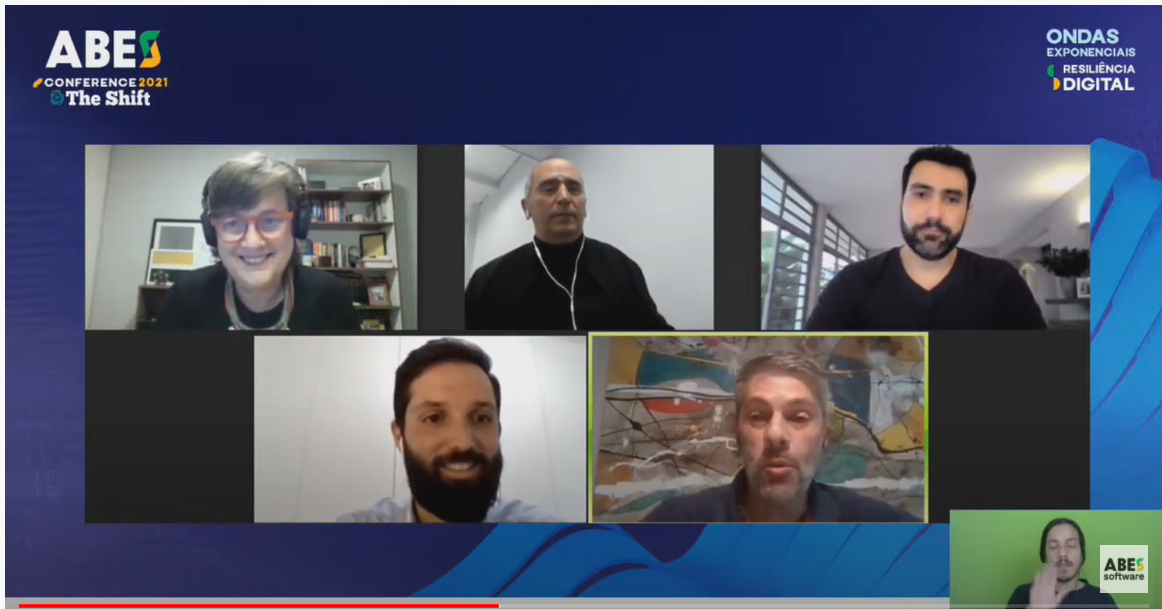
This was the north of the debate "The journey to sustainable income in the digital economy”, in the first round table of 15/09 mediated by journalist Silvia Bassi, on the second day of ABES CONFERENCE 2021, which was carried out in a fully online format. The event is curated by The Shift portal team and has platinum sponsorship from Oracle and master sponsorship from Amazon Web Services (AWS), IBM, Sky.One Solutions, TOTVS and CAESBRA.
Author of the book “Nova Economia: Understand why the entrepreneurial profile is swallowing the traditional Brazilian entrepreneur” and VP of Finance and Strategy at iFood, Diego Barreto highlighted the market opportunities that technology is currently bringing. “I believe we are living a magical moment. Brazil has always been very far from the technology development process, but what happens right now is the opposite. For the first time, we are seeing the integration of value chains and technology arrives in a more accessible way, which brings countless benefits for everyone. This reduces prejudice when making a purchase, for example. In other words, we can buy an object that was produced by a micro or nano entrepreneur and who displayed his product there on the internet”, explains Barreto.
Fernando Perobelli, Full Professor at the Faculty of Economics at the Federal University of Juiz de Fora (UFJF), says that “the current economy has shown us that, increasingly, it is important to seek better working conditions, more security in terms of job offer as for the consumer, loyalty of employees and building a closer relationship with the worker. This is clearly seen in the gig economy. In the past, self-employed services were limited to a few professions. Now, the meaning of gig economy reached other activities. Just as musicians, day laborers, doctors and lawyers negotiated their values, now designers, programmers and copywriters, for example, are no longer exclusive to a company and can freely negotiate their services”.
The inclusion was also highlighted by the speakers. Cid Torquato, president of ICOM Libras – a platform that translates conversations in real time for deaf people who prefer to communicate in Brazilian Sign Language – highlighted how the pandemic and remote work contributed to the inclusion of people with disabilities.
“In everything we have to see the positive side. Even in the midst of the pandemic, many people were unable to leave their homes and were employed and, in some cases, they took off their business at this very difficult time for everyone, but which opened doors and possibilities for millions of people. In other words, the virtual put everyone on an equal footing in the search for home office employment opportunities or in entrepreneurship”, says the executive.
Igor Cordeiro, Director of Public Policy and Sustainability at Facily, highlighted the need for social inclusion, “we need to build a mechanism in which the most popular groups can participate and, at the same time, be protagonists in this process. And with digital inclusion, we will have a more balanced society", he pondered
THE ABES CONFERENCE 2021 - EXPONENTIAL WAVES AND DIGITAL RESILIENCE took place on September 14, 15 and 16 in free and digital 100% format. The event had its programming organized into daily tracks: digital resilience, business environment and human factor, respectively.
Watch the full presentation at this link: https://www.youtube.com/watch?v=DyTuuqT51Tc&list=PL2X1JJqBpAkO3FnrSADlajyDI-OVS5dBp
Subscribe to the ABES YouTube channel: www.youtube.com/abessohotware