



Innovation is the result of a public call launched by Aneel for the development of efficient electric mobility solutions
The battery is the main component of a 100% electric vehicle – a market that has been growing in several countries around the world, mainly due to efforts to reduce greenhouse gas emissions into the atmosphere. However, it is normal that, after a few years of use - and many recharge cycles -, the battery begins to lose capacity and is no longer able to reach its maximum charge, which affects the autonomy of the electric vehicle. What to do with these batteries that are no longer suitable for use in vehicles, but still have a good part of their capacity preserved?
 This is the focus of an innovative project being developed by CPQD in partnership with CPFL Energia and the manufacturer BYD, as part of a public call by the National Electric Energy Agency (Aneel), launched in 2019, aimed at creating solutions in the area Efficient Electric Mobility. “This is a strategic research and development project that was born within the concept of RISE – Electricity Sector Innovation Network”, says Aristides Ferreira, manager of Solutions in Energy Systems at CPQD. “The objective is to develop a solution destined to give a second life to lithium-ion batteries used in electric vehicles”, he adds.
He explains that, depending on the use, the duration of a lithium-ion battery in an electric car is approximately 8 to 10 years – from then on, the user's perception of the vehicle's loss of autonomy increases, since the battery suffers a reduction in its ability to store energy. With the second life project, it is possible to give it another 5 to 10 years of use in different applications, such as storing energy generated by photovoltaic systems and other intermittent sources, or as a backup in telecommunications stations, for example.
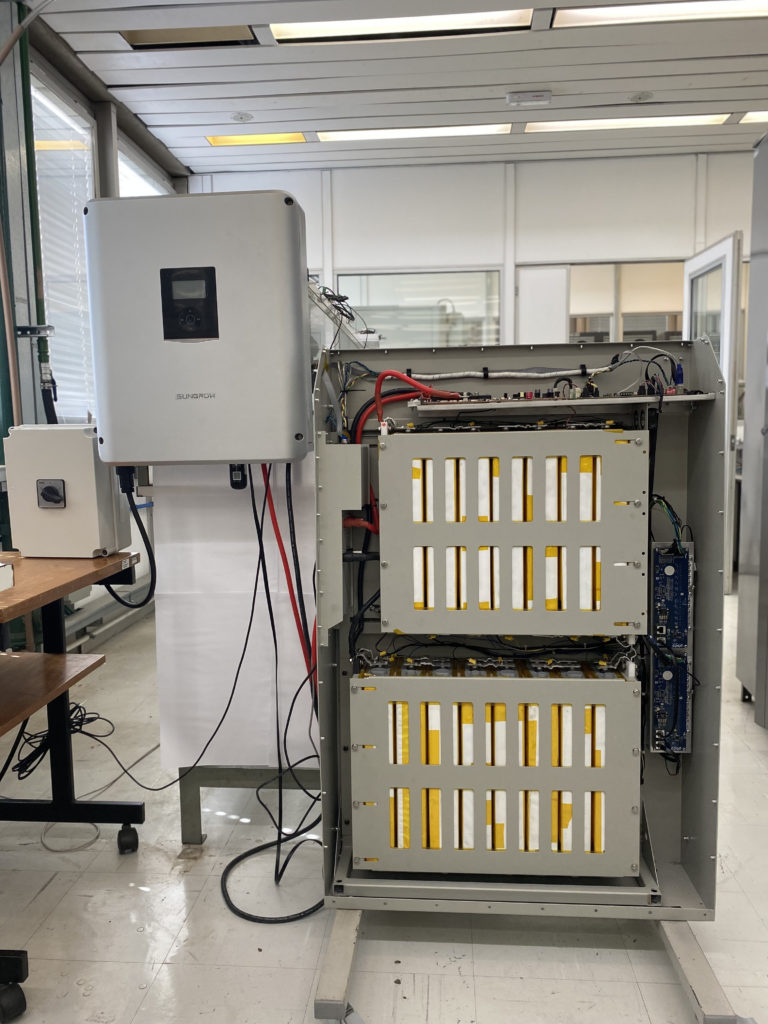
Vitor Arioli, researcher in the area of Energy Systems at CPQD, says that the development of the project began with carrying out, in the laboratory, several tests and measurements on degraded electric bus batteries, supplied by BYD. “The lithium-ion battery is made up of several cells, which form a pack”, he explains. “The work in the laboratory involved the analysis of around 500 cells supplied by BYD and, based on that, we developed a methodology for evaluating and selecting the most suitable cells to compose a second-life battery”, points out Arioli.
In addition to this methodology, CPQD developed algorithms and the prototype of the second life battery itself – which includes hardware, mechanics and the management system known as BMS (Battery Management System). It also carried out a proof of concept (PoC), at its facilities in Campinas, and a series of cycling tests aimed at accelerating the aging process and determining the real duration of a battery in its second life. According to Arioli, there were about two years of rehearsals and tests with this focus.
The next step will be a PoC at Unicamp, where a photovoltaic energy generation plant is installed. “In this case, the intention is to carry out assessments aimed at guaranteeing the quality of energy from the electrical network with the use of this second-life battery”, reveals Aristides Ferreira. This proof of concept will close the project – its completion is scheduled for September – and, from then on, the technology will be ready to be transferred to the company responsible for manufacturing and selling the second-life battery in the market.