



IT executives cited lack of talent before implementation cost and security risks
According to the latest research from the Gartner, Inc., the world leader in research and advice for companies, the shortage of talent is the main barrier to the adoption of emerging technologies. The study shows that 64% of IT executives identify labor as a complicating factor in this transformation process, compared to just 4% in 2020. Lack of availability of talent was cited far more often than other barriers this year as cost of implementation (29%) or security risk (7%).
The availability of talent is cited as the main inhibiting factor for implementing new solutions in all six technology domains included in the survey – computing infrastructure and platform services; network; safety; digital workplace; IT automation; and storage and database. IT executives cited the availability of talent as the top adoption risk factor for most IT technologies. IT automation (75%) and nearly half of digital workplace technologies (41%).
"The continuous effort towards the remote work and the acceleration of hiring plans in 2021 has exacerbated the shortage of IT talent, especially for IT skills. sourcing, that enable the use of Cloud, Edge Computing, automation and continuous delivery,” says Yinuo Geng, Vice President of Research at Gartner. “As an example, of all the IT automation technologies profiled in the survey, only 20% of them have advanced in the adoption cycle since 2020. The talent issue is to blame here.”
Investments and deployments of emerging technologies are accelerating – Despite the challenges in hiring talent, IT and Infrastructure and Operations (I&O) leaders say they have increased their adoption of emerging technologies to drive innovation as organizations begin to recover from the pandemic.
Across all technology areas, 58% of respondents reported an increase or a plan to increase investment in emerging technology in 2021, compared to 29% in 2020. In addition, I&O functions witnessed a reduction in deployment times, with all the technologies being deployed are expected to reach adoption in the next six to 18 months.
“This indicates that organizations are more comfortable directly deploying new technologies to accelerate growth, rather than relying on a long observation period to develop the business case,” says the analyst.
In addition, more leaders (in and out of the IT function) are influencing technology investment decisions this year, driving the trend towards “democratized delivery”. By 2021, 82% of IT leaders either agree or fully agree that business leaders outside of IT influence emerging technology adoption decisions across all technology domains assessed.
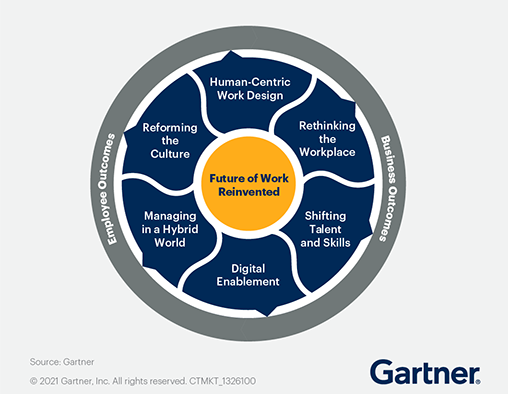
Future of Work Reinvented – https://www.gartner.com/en/insights/future-of-work
Cloud and prioritized security technologies – Resilience and improving critical IT infrastructure are top priorities for I&O teams and other IT leaders in 2021, according to the survey. As a result, they are prioritizing deployments of A cloud and investments in security technologies.
To enable the movement of information between physical and virtual locations, organizations are investing heavily in building a solid Hybrid Cloud foundation, supported by Multicloud technologies. Distributed Cloud systems, Cloud access security brokers (CASBs) and Cloud-based enterprise resource planning (ERP) are among the applications reaching the deployment phase in 2021, with respondents stating that resilience is paramount investment driver for 63% of these Cloud technologies.
In addition, infrastructure security is a significant priority for organizations as they deal with growing threats, especially for mobile devices. Endpoint and hybrid work environments. From 2020 to 2021, the number of security technologies being implemented increased sharply – from 15% to 84%. In 2021, 64% of respondents reported that they have increased or plan to increase investments in security technologies, up from just 31% in 2020. “Tech leaders who don't review their infrastructure security strategy will face many challenges with new cyber attacks in their organizations,” says Geng.