



 *By Anderson Rohe
Nowadays there is much speculation that O hype gave way to the AI bubble., ...and that the vibrant phase of large language models (LLMs) has stagnated. Since the The technological leap truly came with the transition from GPT-2 to GPT-3, as well as from GPT-3 to GPT-4.. This does not appear to be the case with GPT-5, where there has been an incremental gain in relation to certain capabilities of previous AI models, such as... to be more precise and handle multiple tasks more easily, however not exactly a revolution in the sector.
Especially because there are those who I disagree that Artificial General Intelligence (AGI) should be the next step in AI., much less with the frantic drive towards intelligent autonomous systems and to Full automation / end-to-end coming from them (in order to to get closer and closer to human skills, and thus fulfill the goal set from the beginning by Silicon Valley, (almost in a prophetic tone).
Therefore, the race is on to achieve an AGI and then a Superintelligence. That would be an exaggeration., as well as having them as an ultimate goal a A major strategic error stemming from an illusion. The utopian tendency of human beings to overestimate their true capabilities: for example, the optimistic view that only We are going through a transitional phase of disillusionment, moving towards greater maturity of the systems and consolidation of expectations.. As can be seen from its shockwaves:
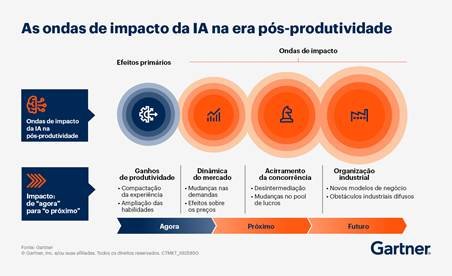
Source: https://emt.gartnerweb.com/ngw/globalassets/intl-br/artigos/ondas-de-impacto-da-ia.png
When, in practice, it would be necessary A course correction to address the current limitations of technology.Because we could even reach a Superintelligence level, at best, only in 2030; however, it will be far less intelligent and advanced than expected.
Ultimately, part of this distortion of perceptions regarding the future of AI stems from the industry's insistence on... LLMs (large language models) and in architecture Transformer which it bases its starting points on, since there would be other possible paths to get there.
Furthermore, a great deal of money is being invested in "an AI that will surpass human intellect," but fueled by unrealistic expectations of a quick return. Just as there is no consensus or sufficient guarantees that this will actually happen, given that "there are clear limits to current probabilistic systems." This situation, therefore, recalls classic periods of crisis which support the thesis that The AI bubble is bound to burst at some point., inflated by surge in the value of technology companies. It is therefore a question not of "if," but of "when," according to various sources. From the Bank of England; from Jamie Dimon, head of JP Morgan; and even from forecasts by the IMF – International Monetary Fund..
Not by chance, this feeling that the future is uncertain and that we live in a relationship of ambivalence and contrasts with the direction of AI is reflected in recent data published in reports from Pew Research Center It's from Global Government Technology Center Berlin in partnership with the World Bank. That is, we are still grappling with ambiguous feelings of hope and uncertainty, trust and disbelief in the face of advances in AI autonomy and to the risk of losing control over it.
What do the reports say?
Based on analyses conducted globally, including public perception in Brazil, that is, 'how people view AI', for the Pew Research Center “"More people are concerned than enthusiastic about its use." Therefore, there is a mix There is a mix of enthusiasm and caution involved: many see it as an inevitable step, although they fear its immediate impacts on work, employability, and ethical issues. Interestingly, countries with clearer and more transparent regulatory frameworks tend to show less fear and, consequently, greater social acceptance of AI. Thus, they trust national models for regulating it more than foreign ones.
The trust factor depends more on the level of transparency than on technical knowledge itself. Thus, in general, the majority, that is, 611% of adults, say they use technology in their daily lives, but only 43% believe that it is used responsibly by government agents and companies. In developed countries with more advanced economies than in developing countries, however, trust is lower, demonstrating that proximity to technology alone does not reduce fear. The research associates this reversal with... Tech fatigue and saturation in use.
Brazil stands out as one of the most concerned countries, with an index of around 34%, above the global average. Slightly more than half (52%) are more apprehensive than excited about AI. And only 22% of Brazilians expressed enthusiasm, although 61% have already used AI in some way. The country, therefore, combines low levels of confidence with high exposure, reflecting a diffuse sentiment regarding the ethical and social impacts of the technology. This demonstrates that familiarity with the technology is not the same as collective acceptance.
The study also reveals different perceptions depending on the generation and level of education assessed. Thus, young people and those with higher levels of education tend to view AI more positively, while older adults with lower incomes are more concerned about loss of control and security.
Overall, the research points to a collective optimism, albeit a restrained one: most people recognize the potential of AI to improve their lives, but still have doubts about the ability of companies and governments to control it ethically and transparently.
In turn, the report The Agentic State, the result of joint work between the Global Government Technology Center Berlin and the World Bank, The book, co-authored by Brazilian Tiago C. Peixoto, a specialist in technology and government, discusses the advancement of Artificial Intelligence agents in public service, anticipating a revolution yet to come, with greater intensity in the year 2026. It promises systems that, unlike current models, will be able to solve problems and perform tasks, acting and making decisions on their own, independently and with less dependence on humans, "reasoning" even within pre-established rules.
The aim here is to investigate what AI agents are and how they will contribute to the development of large language models – LLMs let them now be“the brain provided with the hands of automation”The goal is to make the public machine not only more useful, faster, and more efficient, but also smarter, cheaper, and more reliable, in order to promote structural changes and thus reduce bureaucracy in the services provided. This involves the government interacting as if it were a digital assistant that automatically finds and resolves issues.
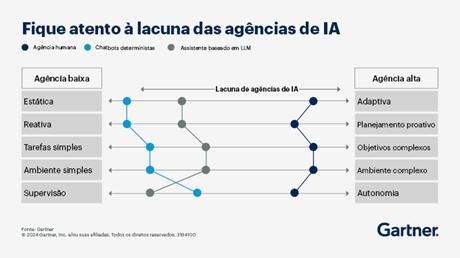
Through five levels of agency, The report compares this new model of "Agentic State" to a public administration that not only does what it has already been doing, but also "redefines" the role of public power in a world of "“co-pilot” with the citizen. As the document's subtitle itself states, “"It rethinks" the role of government in the face of this new era of transformation from generative AI to AI agents, proposing a paradigm shift. through the implementation of these agent systems.
The change will not be automatic. The "turnaround" is therefore in the sense of restructuring the business through which a A fully matured AI agent will also begin to "learn and decide" from the environment and the user's daily experience., ...but in conjunction with human intervention, in a gradual, supervised, and more transparent way than before, going beyond the mere digitization of public services. This scenario is supported by market projections: according to... Gartner and the Forrester – consulting firms that offer insights about marketing, Business, customer experience, and technology so that executives and their companies can make better strategic decisions.
The reason for the change of direction.
However, the question arises as to the urgency of this task force, stemming from the current need for governments and artificial intelligence to work side-by-side in order to minimize bureaucracy and serve the citizen, placing them at the center of attention. Interestingly (or not), this is a consequence of movements running parallel to that of total automation: that of... backlash and The bursting of the personalization bubble. Thus, in the face of legal proceedings arising from Given the many shortcomings of AI, there are calls for a return to human customer service., ...at least until there is significant and efficient progress in the sector. This is precisely because of the fear that, with the accelerated adoption of AI agents, the public machine will lose its way and tend to become even more obsolete and inefficient, generating frustration for the already dissatisfied citizen. Because as things stand, agentic AI tends to further amplify this... gap or obsolescence gap, “unless governments improve their performance”.
Source: https://emt.gartnerweb.com/ngw/globalassets/intl-br/artigos/agente-inteligente-em-ia.png
The central contribution of these studies, therefore, is that the adoption of AI, especially in the public sector, should not be merely technical but also institutional, geared primarily towards the reality of developing countries, such as Brazil, where the aim is to reduce inequalities through the acceleration of digital transformation. Those who fail to do so in time will not only risk falling behind but also becoming dependent on those who already possess technological expertise.
Conversely, blindly following typically neoliberal prescriptions in the name of increased productivity and reduced costs can mask an even more asymmetrical situation: when humans increasingly delegate critical tasks and activities to supposedly intelligent systems due to their end-to-end, real-time automation, From data analysis to decision making., Even when supervised, these practices can, conversely, lead to the much-feared gradual loss of human autonomy and control.
The diagnosis
Today, there are indeed differing voices arguing that the Artificial Intelligence industry is not on the right track because it insists on advancing a model limited by its own probabilistic nature, the LLMs. Then, Unlike the AI agents that are to come and will operate more autonomously and independently, they only respond to... prompts that the users did. This is a strategic error on the path to a Superintelligence that may become greater than our own. But, nevertheless, we would still be far from achieving it., in a previous and earlier phase of transitionFirst with Generative AI, and now with Agentive AI, until we actually manage to achieve it.
On the other hand, there are those who say, like Professor Anat Admati, from Stanford Graduate School of Business, what It's difficult to engage in this exercise of futurology and predict a bubble until it bursts.. Empirical data, however, points to the contrary. Reading the reports, one gets the impression that the future of AI will depend not only on technical advances in the technology, but also on trust in who uses and develops it, how it is used, and how.
Because when we no longer understand what the machine does, or we blindly trust its results, even if they appear to be more functional than our own, the entire integrity of the decision-making process can be seriously compromised by opacity.
The question then remains: what will become of the human element in the history of AI, as we are about to delegate much of our autonomy and individual freedom in exchange for supposedly greater efficiency, productivity, and reduced costs in the provision of digital services and products? Would the cost of this really be worthwhile? trade-offOr is there not necessarily a trade-off between the two, and could a balance be achieved in practice? Only the next steps towards a truly more advanced and independent artificial intelligence will tell.
*By Anderson Röhe, Senior Fellow Researcher at the ABES Think Tank (GT-IA)
Notice: The opinion presented in this article is the responsibility of its author and not of ABES - Brazilian Association of Software Companies
Article originally published on the TI Expertise website: https://tiexpertise.com.br/o-estado-atual-da-inteligencia-artificial-agentica/