



Strategic partnership delivers enhanced enterprise mobile security for the modern workplace
Samsung Electronics Co., Ltd. recently announced the first step in reimagining mobile device security for enterprise customers, in partnership with Microsoft. This collaboration resulted in the industry's first on-device hardware-supported mobile device certification solution that works well on both corporate and individual devices.
Device certification helps ensure the identity and health of the product by verifying that it has not been compromised. Certification of devices with hardware support built into the device – available on Samsung Galaxy products1 and combined with the protection offered by Microsoft Intune – now provide more security and flexibility. For businesses, this represents an additional layer of protection against compromised devices attempting to falsely impersonate known, secure devices in order to gain access to sensitive corporate data. Additionally, companies now allow employees to bring their own equipment to work, ensuring they are protected with the same level of security found on corporate devices. For employees, this represents additional flexibility for the Galaxy products themselves to safely access the work environment.
In a rapidly evolving scenario with changes in work habits and increasingly sophisticated cyber threats, the Zero Trust is a security model based on three principles: always assume the breach, explicitly verify, and provide least privilege access. Zero Trust implementation has become mandatory in regulated industries and for public sector clients such as the United States government2. This requires a new approach to strengthening end-to-end security, from applications to the network to the device itself, regardless of equipment ownership and registration.
Together, Samsung and Microsoft are uniquely positioned to achieve this goal. The Samsung Knox security platform has been around for 10 years. During this period, Samsung Knox has been activated on more than a billion Samsung Galaxy devices. More than 30,000 companies in 110 markets trust Samsung Knox to protect their devices against cyber attacks. Microsoft is the industry leader in unified endpoint management software market share3 and offers end-to-end, multi-platform, multi-cloud security solutions that integrate multiple categories across security, compliance, identity, device management, and privacy. These solutions are powered by over 65 trillion threat signals every day4. With this partnership, the first hardware-based mobile device certification connects the consumer to the world of work, enabling people to safely bring their personal devices to work.
“Samsung is committed to meaningful innovations that are both secure and versatile and optimized,” said KC Choi, EVP and head of the Global Mobile B2B, MX Business team at Samsung Electronics. “As work habits evolve and people work from virtually anywhere on any device, we are paving the way for the future of corporate device security, and democratizing the ways for companies to better protect their information.”
Flexibility for businesses and end users
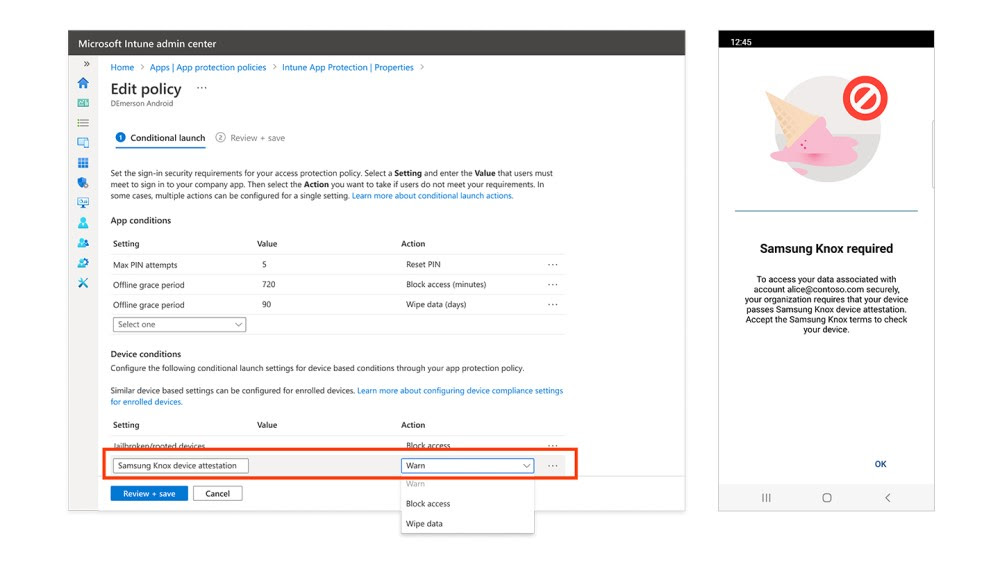
For enterprise IT managers, hardware-based mobile device certification with Intune provides strong protection for corporate needs without impacting the user experience. With this integration, even highly regulated organizations can adopt a Bring Your Own Device (BYOD) policy with this additional layer of protection on Samsung devices, which are widely used by consumers and professionals for work purposes. This increases worker productivity, provides better user experiences, and simplifies administration.
Joint Samsung-Microsoft solution works on both managed and unmanaged devices, regardless of ownership5. Traditional device certification works primarily on managed devices as it is server-based and requires network connectivity, which means the entire device must be registered with the corporate system.
With hardware-based mobile device certification, companies can verify the health of a device and allow access to the corporate system, whether managed or unmanaged. The user experience is also simplified to allow employees to take their personal devices to work and securely access the corporate system without additional security steps.
“Samsung’s hardware and software solutions are market leaders. Combined with the power of Microsoft Cloud and Intune, they uniquely position us to empower defenders with end-to-end capabilities to thwart sophisticated malicious actors and improve Zero Trust security posture,” said Michael Wallent, CVP of Microsoft Security Management. “With this partnership, we are committed to continued innovation that will ensure the most security-conscious businesses have the best mobile device protection possible.”
For more details, see https://aka.ms/
1 Supported on select Samsung Galaxy smartphones and tablets, including “Security by Knox” devices running Android OS 10 or higher. To qualify, devices must be running Android OS 9 or a newer version at the time of release.
2 “Improving the Nation's Cybersecurity,” Executive Order No. 14028, 86 Fed. Reg. 26633 (May 17, 2021) https://www.whitehouse.gov/
3 Source: Worldwide Unified Endpoint Management Software Market Shares, 2022: A Tactical Management Tool Evolves into Strategic Data Platform – Printer-friendly – US50467223 (idc.com)
4 Source: Microsoft 2Q FY22 earnings release. https://www.microsoft.com/en-
5 Hardware-based mobile device certification, enabled by Samsung Knox hardware policies and Microsoft Intune app, is compatible with Mobile Device Management (MDM) and Mobile Application Management (MAM) systems for use on company-owned devices as well as personally owned devices.