



Xiaomi moved up to second in the rankings, while Apple dropped to third.
Global smartphone sales to end consumers totaled 328.8 million units in the second quarter of 2021, an increase of 10.8% per year, according to research by Gartner, Inc.., world leader in research and advice for companies. Gartner analysts point out that cell phone sales grew by 10.2% despite restrictions generated by COVID-19 and component shortages.
“Instructions to beef up local inventories and plant closures in India and Vietnam due to the new wave of COVID-19, along with retail business closures and online delivery restrictions negatively affected smartphone sales in the second quarter after a strong start in early 2021,” says Anshul Gupta, Senior Director of Research at Gartner. “However, regions with the largest network and 5G connectivity saw strong demand for 5G smartphones and were growth drivers for major smartphone vendors.”
Samsung expanded its entry-level and mid-priced 5G smartphone lines to address new growth opportunities in the 5G segment in the second quarter of 2021. The company maintained its number one position among the top five global smartphone vendors. While it remains the market leader, Samsung's annual growth has slowed due to supply constraints and production disruptions.
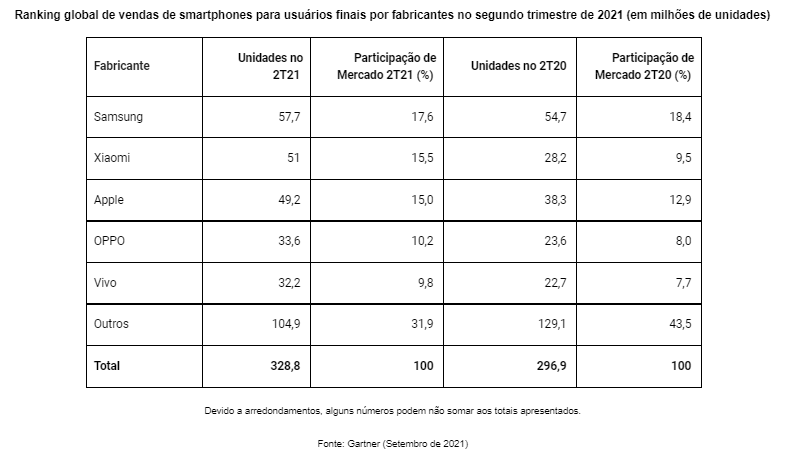
Worldwide sales of Xiaomi smartphones surpassed Apple in the second quarter, placing Xiaomi in second place for the first time. The company posted 80.5% growth in its smartphone sales due to a stronger online presence and rapid expansion in global markets beyond Asia Pacific, led by investments in retail channels and partnerships with service providers. communication (CSPs). Apple's sales grew 28.3% and its market share increased 2.1% per year. “Apple's aggressive sales promotion for its iPhone 11 and iPhone SE smartphones (2020) has boosted its growth in the price-sensitive segment,” says Gupta.
Other Chinese smartphone vendors such as Oppo and Vivo grew 42.4% and 41.6%, respectively, in the second quarter of 2021. Aggressively priced mid-range smartphones, a wider distribution network and robust marketing campaigns in Western Europe boosted the Oppo's growth. Vivo continues to expand its presence in the Asia-Pacific market, starting to expand its actions with a focus on Europe, Middle East and Africa.
“Smartphone demand remained strong this quarter as buyers preferred higher specs and better user experience. The pent-up demand of 2020 continues to generate an advantage for the world's smartphone providers in 2021”, highlights the analyst.