



Reinvention of Submarine Cables, Development of IoT and Use of 5G frequencies were some of the highlights of the last day of the largest innovation, connectivity and digital transformation event in Latin America
Informa Markets announced the winners of the Sustainable Booth Award for the 23rd edition of Futurecom
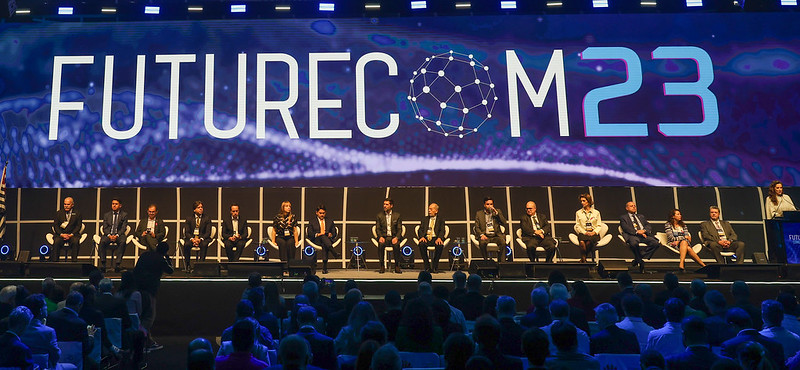
The 23rd edition of Futurecom comes to an end with an audience of 32 thousand visitors and the presentation of the Sustainable Stand Award. The winners were DocuSign, Deutsche Telekom, Ciena Communications Brasil and American Tower do Brasil, representing the Green, Yellow, Blue and White categories respectively.
Discussions about the growth of the telecommunications sector in Brazil were also highlighted. The panel “The reinvention of Submarine Cables: New dynamics, business models and new entrants to the game” showed how the entry of OTTs changed the dynamics of the submarine cable ecosystem, changing prices and leading providers to diversify services. The debate was attended by Tatiana Fonseca, EVP of Operations at Cirion; Rafael Lozano, Country Manager at Ellalink; Marco Canongia, Director of Lumicom; It is Alexandre Solomon, Country Manager at Infinera.
Rafael explained that generative artificial intelligence gathers information and data from the internet, connects these resources, understands and returns a result. This demands capacity from both terrestrial and submarine networks. The expert believes that the trend is to bring content closer to the user with edge computing, reducing latency and increasing speed.
Tatiana Fonseca agrees that Generative AI will cause an increase in data and that this demand will probably be centralized, as this is the history of hyperscalers – such as Google, Amazon and Meta. To increase capacity in Latin America, Cirion intends to open two new Data Centers, one in Peru and one in Chile, anticipating demand from these countries.
Already Alexandre Solomon said that Artificial Intelligence has already been working on new technologies for submarine cables for many years, such as in network planning to increase the efficiency of existing cables, monitoring cable operating parameters to predict and act in a corrective manner and automating cable routes. backup in the event of cable system failures.
Meeting the demands of companies should be the focus of IoT development
“We need to remember that the Internet of Things” (IoT in English) is not the name of a specific technology, but of a set of technologies that meets business needs”, says the president of ABINC (Brazilian Association of Internet of Things), Paulo José Spaccaquerche, when starting the panel “ IoT: Its new solutions, applied technologies and use cases. The multitude of possibilities that IoT presents for solving pain points in the most varied verticals“".
According to the director of American Tower, Janilson Bezerra, IoT is not a choice, but part of companies' strategy. For the director of IoT and M2M at Claro, Eduardo Polidoro, these productive gains are already happening and are competitive differentiators for companies. Also participated in the panel Roberto Celestino Pereira, Head of Digital Technology Innovation at NTT Data; Alexandre Oliveira Dal Forno, Head of Corporate Marketing and IoT at TIM; André Martins, CEO of NLT, and Henrique Almeida Nogueira, Head of Department at SENAI (National Industrial Learning Service).
Advancement of AIoT faces organizational challenges for companies and governments
Mostly old industrial park, lack of connectivity and different levels of business maturity to work, whether to receive innovations or work on data obtained with technology, are some of Brazil's challenges highlighted by Evair Gallardo, Director of the Brazilian Internet Association (Abranet); Roberto Gomes Correa, Industry Technical Specialist at Intel; Cassio Magnino, Expert Associate Partner at McKinsey, and Ricardo Montanher, Sales Director B2B at Ligga, during the panel “AIoT and intelligent edges: expanding the benefits of connectivity, cloud and hyperautomation data intelligence“".
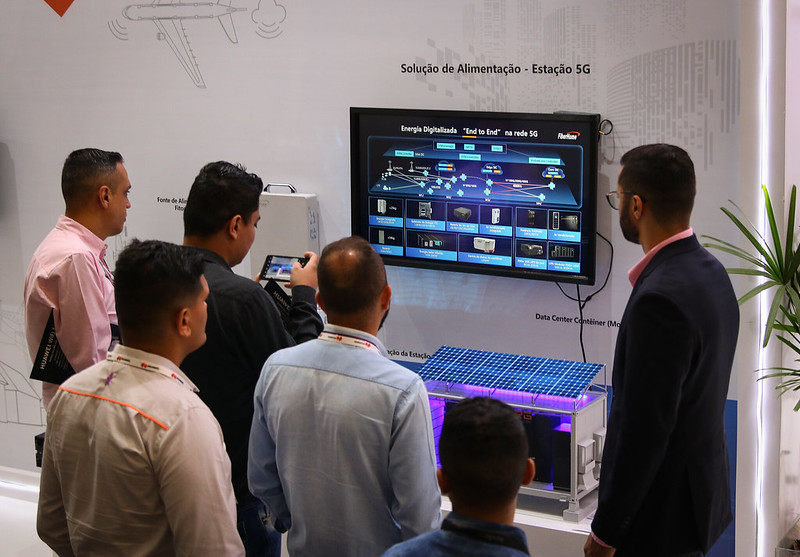 According Magnino, business maturity needs to be identified before applying AIoT in companies. “There are challenges related to data governance. It is very common that internally there is still a debate about who owns the data, whether the technology department or the business department”.
In the opinion of the panel mediator, Israel Guratti, manager Technology & Industrial Policy – Innovation at the Brazilian Association of the Electrical and Electronic Industry (ABINEE), Artificial Intelligence, when used responsibly, brings efficiency to the tasks carried out by people, improving the provision of services and anticipating risks.
5G Frequency Uses
At the end of 2021, the federal government considered operators for the application of 5G in Brazil and established so-called coverage commitments. For next year, for example, Anatel's goal is to increase the number of antennas in the capitals to a minimum of one antenna for every 30 thousand inhabitants. By 2026, 30% of municipalities with a population of less than 30 thousand – which means the majority of Brazilian cities with 4,396 municipalities – will be served by the fifth generation.
To discuss and understand the role of new companies entering this market and their role in this planning, the panel “5G frequency uses: new entrants, decisions (and developments) around 700MHz”.
The debate, mediated by the CEO of Futurion, Caio Bonilha, was attended by Anatel's executive superintendent. Abraham Balbino highlighted the importance of the General Competition Targets Plan (PGMC) to encourage market expansion. “We knew that, as a matter of course, the consolidation of the mobile market would happen. The PGMC was the structuring path of the regulatory process, introducing into the mobile market a concept similar to what was done in the last 15 years in the fixed market”, stated the executive.
“The 5G auction was a piece of the puzzle, but it is not Anatel’s only bet. We are obsessed with competition. In 2017, for example, the fixed market was 92% dominated by large operators, and currently 56% are from small and medium-sized operators. Opening the business to new entrants is non-negotiable for Anatel”, added Abraão.
The presentation also included the participation of Frederico Trindade, executive manager of Business, Training and Consulting at Inatel; José Roberto Nogueira, CEO of Brisanet; Sergio Bekeierman, CEO of Winity; Rodrigo Schuch, president of the NEO Association; Gabriel Codo, partner at McKinsey & Company; It is Felipe Aguiar, TelComp Project Manager.
The ethical uses of AI and the evolution of debates around the Regulatory Framework
The ethical uses of AI have gained new contours in the face of the race towards generative AI. This topic was discussed in the panel “Far beyond science fiction: the ethical uses of AI, the impacts of generative AI, the evolution of debates around the Regulatory Framework and disruptive applications for society”, with the mediation of Jefferson Lopes Denti, Partner of Deloitte, and participation of Danilo Macedo, Leader of Government Relations and Regulatory Affairs at IBM Brazil; Abraham Balbino, Executive Superintendent of Anatel; Alexandre Freire, Advisor to Anatel; Nairane Rabelo, Director of ANPD; It is Dora Kaufman, Professor at PUC-SP.
For Dora Kaufman, there is a difficulty in creating a regulatory framework throughout the Western world, since in a democracy ideas need to be discussed by all sectors. According to the expert, AI is a general purpose technology, that is, it changes the logic of how the economy works.
“PL 2338/2023 is not ready to be a regulatory framework, but it is a starting point,” he said Dora. She believes that it is necessary to bring the whole of society into the conversation, as in Europe, where they created an observatory and a commission of 54 experts to understand how AI is being used.
Nairane Rabelo, from ANPD, also believes that PL 2338 has evolved the discussion and is more mature than other Bills, already demonstrating a concern for reconciling technology with constitutional rights. She sees a tangency with the General Data Protection Law (LGPD), as Generative Artificial Intelligence uses all types of data, including personal data, for its operation. The right to change personal data, automated decision review, transparency in the decision process are some examples cited by the specialist.
Alexandre Freire, from Anatel, talked about his experience with the use of artificial intelligence in the Federal Supreme Court. The Victor Project is an AI that identifies repetitive themes and resources and screens them so that the STF can focus on topics with high demand.
RAFA Artificial Intelligence is also being used to implement the 2030 Agenda, which identifies SDG-related resources and accelerates their judgment. The VitórIA Project is 'Victor's little sister', and its objective is to provide greater organicity to the STF's work, identifying similar matters and grouping them into a single trial, with the aim of combating legal uncertainty and loss of credibility in the Judiciary Brazilian.
Danilo Macedo, from IBM, believes that AI has an impact on everyone, so they need to work together for a regulatory solution. The speaker wants to bring together universities, academic technology centers, companies that develop AI technology, companies and people that use AI and the Government, one of the biggest uses of artificial intelligence with the GOV.BR.
“It is clear that AI brings several benefits and can help solve major problems in society”, Danilo explains with food logistics and distribution and combating climate change. The risks lie in the mistaken use of AI, with the responsibility of those who develop AI tools.
Abraham Balbino, from Anatel, highlighted that AI arises from a natural evolution of information and communication technologies, which, by having the capacity to process a lot of data and information, move from programmed solutions to statistical solutions. “What we want is for artificial intelligence to be focused on humans.” He considers that AI needs to be ethical, sustainable and respect the cultural values of where it is being used.
5G RAN: end-to-end connectivity
Open source platforms and interfaces are fundamental for the development of 5G solutions in the most diverse sectors, and the Open RAN program arrives to offer high performance in education, research, innovation and democratization of internet access in Brazil. The partnership between RNP, CPQD, Inatel and Eldorado was launched in 2021, and is an open and disaggregated 5G network, including intelligent control of access networks.
These were the themes of the panel “5G RAN: OpenRan, RAN Intelligent Controller, server hardware and end-to-end connectivity”, which was mediated by Marco Canongia, managing partner of Lumicom. In the debate, VMware's senior business development manager, Ximena Perez, spoke about the challenge of network interoperability between different suppliers. “Some companies use a wide network with everything from the same manufacturer: software, hardware, controllers. But the objective of the technology is to create a broad ecosystem of partners to offer robust and complete systems, developing specialized software for each function and validating it with our virtualization platform”, stated the executive.
For the director of Sales Engineering at Ciena, Décio Coraça, transport is a fundamental part of this ecosystem and needs to develop solutions aimed at the evolution of 5G, but within an open context and with interoperable platforms. “To absorb any new service, the infrastructure needs to be monetized, generating revenue for the market. Today, with 5G still in its infancy, many of the initiatives are to bring the connection to the largest number of users using the existing infrastructure. From now on, the priority must be to expand the infrastructure in a scalable and integrable way.” explained the director. The panel also included the participation of George Glass, CTO of TM Forum; It is Izabella Coeli, Senior Sales Architect at RedHat.