



Ribeirão Preto College optimizes pedagogical activities with support from Seal of Education
Bento Benedini relies on the support of Seal for Education to implement smart screens and Chrome Books to increase student engagement and improve educational content; the school stands out among those that invest the most in technology and innovation in the interior of São Paulo
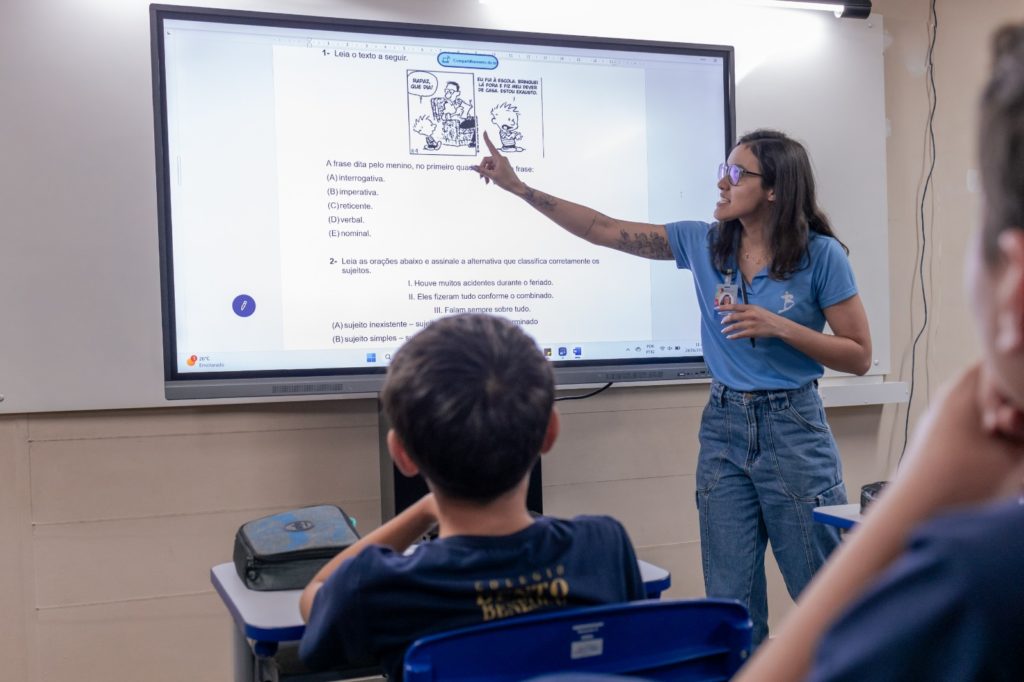
Smartboards increase interactivity for teachers and students at Bento Benedini school, with internet connection, touch screen, multimedia content and accessible technical support (Disclosure / Seal Sistemas)
Bento Benedini, a traditional school in Ribeirão Preto (SP) founded in 1966, was looking for new solutions to increase student engagement in the classroom. The goal was to implement more advanced ways to attract students' attention in the digital age. A recent study by Harvard University (USA) indicates that, on average, most schools currently manage to keep students attentive for up to five minutes – a drastic drop in relation to the 45 minutes of focus that young people maintained before the smartphone era.
It was to combat this dispersion that the Bento Benedini management went into the field to learn about new educational technologies – which included a visit to Bett UK, held in London and considered the largest international event dedicated to the topic. Upon learning about innovations that could be taken to Brazilian classrooms, the school leadership also met representatives from Seal for Education, the education arm of Seal Sistemas focused on integrating end-to-end solutions to accelerate the digital transformation of education.
The partnership resulted in the implementation of smart screens – or smartboards – in six classrooms, in addition to a Chrome Books lab with 50 units installed. With this new educational infrastructure, installed with the support of the brands Acer and BenQ, Bento Benedini began to stand out as one of the schools in the interior of São Paulo that invested the most in technology and innovation to improve students' knowledge.
Connected to the internet and equipped with a touch screen, smartboards offer greater interactivity, advanced features and more accessible technical support, which facilitates the integration of educational technologies into everyday school life.
Available for use throughout the classroom, especially for elementary school students, BenQ's solution allows teachers to go beyond the confines of a traditional classroom. This is because the devices can display high-quality online content, such as videos and other educational information.
Interactivity
Interactivity is another key element, as students can explore the features of smart screens to present their work. Furthermore, when authorized to use their cell phones, students can point their devices at a QR code displayed on the smartboards and instantly download teaching and supplementary materials for the class. This helps teachers save time by eliminating the need to convert these materials into Word or PDF files and then send them to students.
“Students who attend classes with smart screens are much more interested in going to the front of the room to interact with the equipment and answer the exercises. Participation and engagement have increased significantly, as the solution has expanded the pedagogical possibilities and activities in the classroom, making the class content even more attractive,” says Bruna Calil Ciconelli, head of innovation at Bento Benedini.
Currently, teachers and students at Bento Benedini consider smart screens to be very intuitive and easy to use in their school routine. At the school, they replaced old digital whiteboards, which were considered outdated and no longer available in Brazil, which made it difficult to obtain technical support.
Chrome Books
Another change involved replacing tablets with Chrome Books, portable computers aimed at the educational sector and which aim to democratize access to studies with technological tools.
Based on the Google platform, including the use of applications such as Docs, Sheets or Slides, these devices are used by students in all subjects taught at the unit that brings together classes from second to ninth grade. The solution works as a complementary support to the traditional notebook, which continues to be used by students to take notes on the didactic content, supporting the consolidation of knowledge.
The consultancy provided by Seal for Education goes beyond implementation, technical support and project maintenance, as the integrator also focuses on the integration of these solutions into the educational environment. “The issue is not just bringing the technology, but also enabling it to be integrated into the day-to-day running of schools,” explains Emerson Felipe, Commercial Director at Seal for Education.
“It is important that students are clear about why these technologies are implemented in their learning routine. Solutions such as smart screens and Chromebooks prepare students for an inevitable reality that involves the use of technology, which is already very present in everyday life outside of school. Technology helps students to 'learn how to learn', as it is necessary to teach them how to access the necessary information and use this equipment appropriately, with a pedagogical purpose”, says Bruna, from Bento Benedini.
“We are ready to bring to Brazil the best and most advanced educational technology available in the world. The project developed with Bento Benedini has become a benchmark for the use of innovation to benefit students and teachers, fostering learning in the classroom. Our expectation for the coming years is to see more initiatives like this being expanded to other regions of the State of São Paulo and throughout Brazil,” says Emerson Felipe.
“The possibilities of technology in the classroom are endless. We are witnessing the emergence of new educational solutions at an increasingly rapid rate and we have the ability to quickly incorporate them into our portfolio. Our close relationship with the education sector allows us to see how open educational institutions are to embracing these innovations when the goal is to support the learning and work of teachers,” says Wagner Bernardes, CEO of Seal Sistemas.
About Seal Sistemas
With 35 years of experience in the market, Seal Sistemas is the largest integrator of advanced technologies for the entire supply chain in Brazil. The company builds a relationship of trust between the end user and more than 2,000 companies that are part of its client portfolio, through a complete portfolio of mobility and automation solutions, in addition to end-to-end services that include everything from planning to project support.
With the mission of supporting the digital transformation of companies of all sizes, Seal Sistemas expands the Brazilian market's access to the latest global trends in consumption and business automation. Its wide range of solutions and services materializes the application of technological concepts – such as Cloud Computing, Big Data, Internet of Things and Machine Learning – in strategic segments such as retail, logistics, industry, healthcare and education.
Seal Sistemas' successful trajectory is marked by continuous growth and evolution in its strategic direction, from its founding as a reseller in 1988 to its current positioning as a technology integrator. Part of this history is the offering of advanced devices and applications such as ESL (electronic shelf labels), voice picking (data collectors by voice command), the Kairos Warehouse middleware and the Kairos Store software for store floor automation. Its portfolio also includes solutions in mobile computing and automatic data capture, such as printers and barcode readers, and in infrastructure for local and metropolitan wireless networks.
For more information access seal.com.br