



.jpg)
Francisco Camargo, executive president of the entity, opened the event, in which he commented on the exponential impacts of technological development, presented the day's schedule and commented on ABES' growth. Despite the fact that the year had a lower number of laws that affect the ICT sector and business, Camargo considered that legal uncertainty in Brazil stems from excessive regulation, bureaucratization and tax complexity.
Jorge Sukarie, chairman of the ABES Board, who presented the study to those present at the entity's event, which brought together some of the main businessmen and authorities in the sector, highlighted that Brazil remains in 9th place in the world ranking of software and services, with a market of US$ 18.6 billion (equivalent to about 1.6% of the world total, which was around US$ 1.14 billion in 2017). According to the data, the country is very close to the market size of nations like the Netherlands and Italy, which occupy the 10th and 11th positions, respectively, and just behind Australia, which ranks 8th on the list. Overall, all Brazilian indicators had subtle increases from 2016 to 2017, as the total number of companies operating in the sector – which went from 15,700 to 17,000.
"The year 2017 showed a resumption in the growth of the IT sector in Brazil, after a difficult 2016. As we already disclosed in the first preview of the study, investments in Information Technology in the country grew 4.5% in relation to the previous year. It was the year of the beginning of the recovery that we hope to continue in 2018, with the resumption of investments in technology, which can no longer be postponed. ", says Jorge Sukarie, president of the ABES Board, who presented the study to those present at the entity's event, which brought together some of the leading entrepreneurs and authorities in the sector.
Another interesting data are the characteristics of Brazilian software developers: 49.3% of them are considered micro (that is, with 10 employees or less), 46.2% small (from 10 to 99 employees), 4% medium (between 100 and 500 workers) and only 0.5% large (over 500 employees). "These numbers underscore the importance of promoting incentive and promotion policies for small and medium-sized companies, which are essential for the Brazilian software sector to advance and digitally transform the country," adds Sukarie. Today, the software sector represents 1.9% of the national GDP (Gross Domestic Product).
In addition to mapping all the points related to the reality of the market, the study also points out trends for 2018. The current projection indicates that the Brazilian information technology market will grow 4.1% in 2018, following trends such as the maturation of technologies linked to the Internet das Coisas – according to IDC, next year, the IoT will move US$ 8 billion in Brazil, with US$ 612 million in the domestic market, with 4% of homes already using some type of connected device.
Another movement noted is the expansion of the market for tablets and smartphones to the corporate sector (which, in 2018, will have an estimated sales volume of 3.5 million units, or just over US$ 1 billion in Brazil, representing 6% of the total ). Among the different innovations mentioned by the study, which should boost the economy, are Big Data/ Analytics, Cognitive/AI, public cloud and multicloud, among others.
Download the ABES/IDC study here.
Tributes
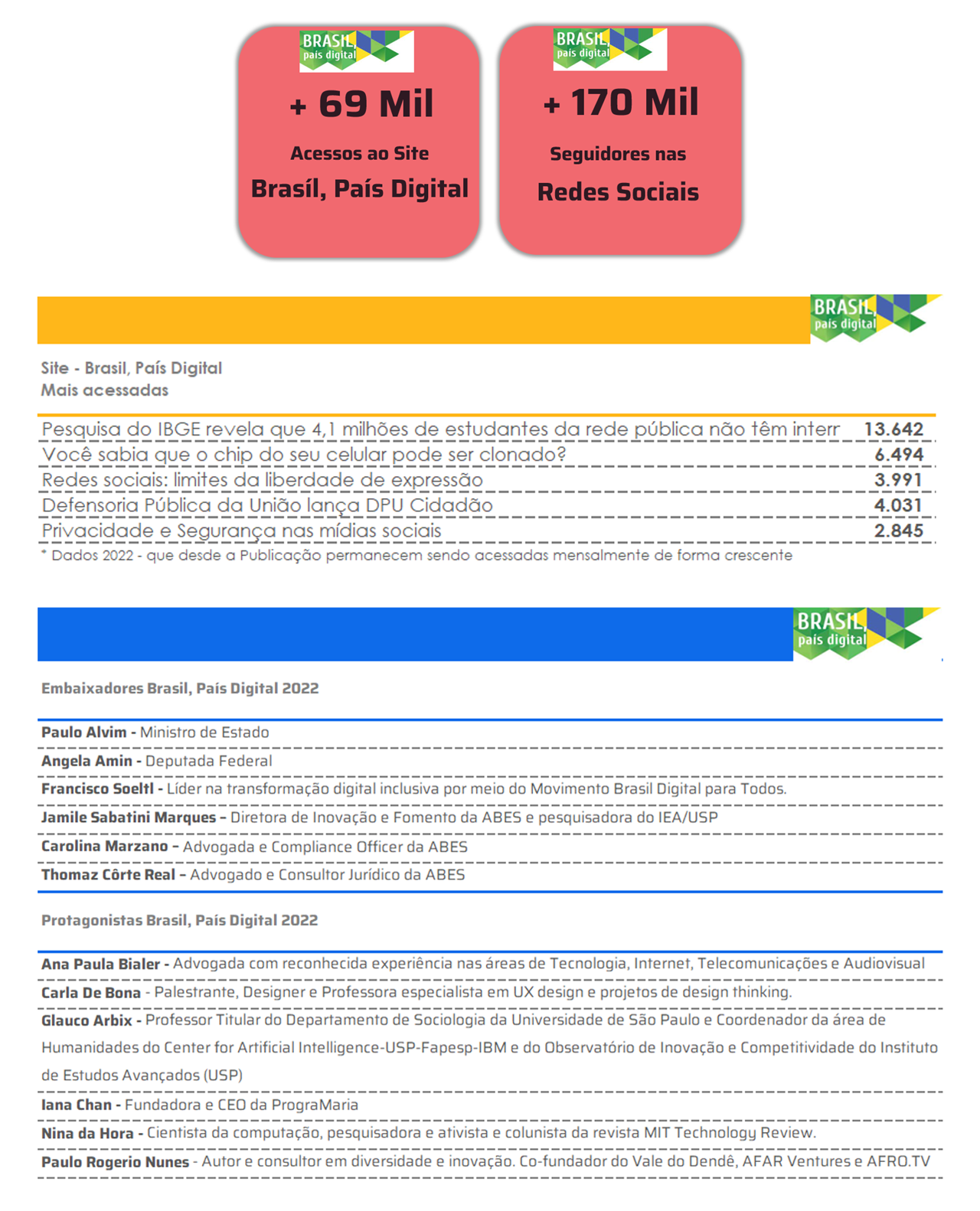
In a breach of protocol after the last lecture, Fábio Rua honored Francisco Camargo with the Commendation of Ambassadors of the Brasil País Digital Movement, an honor offered by the Movement Brazil Digital Country, a non-profit, multisectoral initiative led by ABES that seeks to inform the general public about digital transformation, data use and cybersecurity.
In several moments of the presentations agenda, the 32 years of ABES and the advances of this period were hailed. In 1986, the entity was founded with 18 associates and today represents more than 2 thousand companies, of all sizes and spread across all regions of the country, in 23 states of the federation. "In these three decades we have witnessed a real revolution. Today, a dentist has more technology than entire companies, using resources ranging from the use of three-dimensional scanners to 3D printers. In the coming years, these advances will be even more noticeable and faster, so it is essential that the sector has Legal and Tax Security, an environment open to the development of innovation and entrepreneurship in Brazil."Software today is infrastructure and as such must be considered, essential for the future of the country", concluded Francisco Camargo.
This year, the conference had as its central theme “Digital Transformation of Brazil and Public Policies”, and had more than 20 speakers and panelists of the highest level, rooms for business meetings and an area for company exhibitions. The event was sponsored by IBM Platinum; SigninaForte, Intel and EMX Tecnologia, as premium sponsors; Caesbra Benefits and Microsoft, gold sponsors; and Totvs, silver sponsor. Partners and supporters: Finep, INPI and BNDES; ACATE - Catarinense Association of Technology Companies; ASSESPRO - Association of Brazilian Information Technology Companies; BRASSCOM - Brazilian Association of Information and Communication Technology Companies; FENAINFO - National Federation of Computer Companies, and SOFTEX - Association for the Promotion of Brazilian Software Excellence.
The event was followed by the Seminar "Brazil 2022 - Independence (Digital) or Death (Competitive)?, in which a study was presented that lists priority and suggested public policies for Brazil to achieve its "Digital Independence" as early as 2022, the year that marks the 200th anniversary of Brazil's Independence. Made according to the election year, the document was prepared by Think Tank Brasil 2022, composed of some of the most influential names in the IT sector.
As a result of this situation, all presidential candidates were invited to present their plans in the area of digital transformation and received a copy of the study as suggestions from the IT sector for the social and economic development of the country. The seminar was attended by Henrique Meirelles (MDB), João Amoêdo (Novo), José Maria Eymael (DC) and Kátia Abreu (PDT - vice-president of Ciro Gomes).