



Study “Banks in 2035”, sponsored by SAS, also shows that 86% of respondents believe that the industry should “engage more”
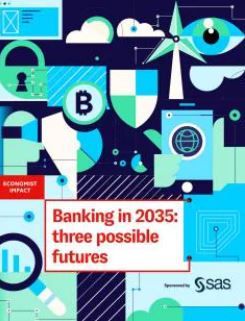
Between dynamic market shifts, rising geopolitical tensions, cyber threats and a worsening climate crisis, the world faces risk and uncertainty on many fronts. How are these and other prevailing trends reshaping financial services? A global study on the future of banking, carried out by Economist Impact – and sponsored by analytics leader SAS – portrays a sector in transition, contemplating a more conscious and determined trajectory.
 The report highlights impressive support for more socially responsible business practices. When asked about the role of the financial services industry in promoting the social good, the survey reveals that:
- Three-quarters (76%) of executives believe that industry “has a strong obligation” to address social needs and issues. In Latin America (AL), the percentage is even higher: 80%. And a third (32%) say industry should play "a central role".
- Approximately four in five (79%) believe that the industry should be “more engaged” in addressing social issues. In AL, once again, the percentage is higher: 86%.
- The vast majority (82%) believe that financial services organizations could improve society while pursuing profit. Again, in AL the percentage is higher (84%).
The risks are many – but so are the opportunities
The study found cautious optimism among executives at banking institutions, even in the face of disruptive trends, internal and external barriers, and growing social and environmental issues, including:
- A digital revolution on the rise: the “digitization of financial services and the adoption of emerging technologies” led the industry's most influential trends, cited by 55% of respondents worldwide. The emergence of digital currencies was close behind, cited by 49% of executives. These trends also topped the industry's biggest opportunities, each cited by 54% of respondents. In LA, however, the order of the most influential trends is reversed: the emergence of digital currencies appears first (58%), followed by the digitalization of financial services (54%).
- Increased cyber risks: The growing threat of cyber-attacks was the most cited risk among trends, recognized by 53% of respondents. In AL, the percentage rises to 56%. How have banks reacted? Nearly half (49%) of executives specified investing in security and data protection as a key strategy for staying ahead of trends; 44% also pointed to better data sharing between their fraud detection systems, digital payments and anti-money laundering activities.
- Environmental, social and governance (ESG) issues. A majority (64%) of executives believe that banks follow the lead of other industries in advancing ESG goals – but it is clear that banks' agenda is gaining more focus. In AL, the number is lower (58%). Two out of five (41%) executives cited ESG as a top opportunity for the organization, while in LA the percentage stands at 36%. About half (52%) named environmental sustainability and climate change as key strategic points of engagement to address social needs.
“What resonates in the financial services industry is: banks are the future,” says Theo Lau, renowned industry commentator, author and founder of Unconventional Ventures. “Investing in social and environmental good, promoting transparency of innovative thinking beyond compliance, and making banking fully digital and more accessible to populations with little or no access to banking – these are not superfluous concepts. They are essential to help banking institutions develop missions and business models that offer new value to stakeholders and promote a better future for people and the planet”.
Analytics is a fundamental part of the path
Whatever happens, executives recognize the importance of technology in building resilience and establishing a better future – both for organizations themselves and for the industry as a whole. Nearly half (48%) named advanced analytics as the most important technology needed to keep their organizations competitive as long-term trends redefine banking. The percentage is almost the same as seen in AL: 47%.
Just as more than three-quarters (77%) rated their organizations as No. right way (35%) or forward (42%) in meeting its digital transformation goals. In AL, the number is 74.2%.
In fact, digital transformation tops the list of strategic priorities that executives will focus on over the next three to five years, mentioned by 57% and followed by security and data protection (55%). Customer experience and risk management were close behind, with 39% each.
“All the potential we see for banking in 2035 will be powered by analytics and AI in the cloud,” says Alex Kwiatkowski, director of global financial services at SAS. “Industry leaders understand that they cannot scale a change of this magnitude without bringing insights to the organization that are easy to share with stakeholders and the public. Achieving optimal performance is only possible by making the best data-driven decisions.”
The global study report Banks in 2035 explores insights shared by nearly 500 decision makers, directors and executives from corporate, commercial, retail and digital banks around the world, with 129 respondents from Latin America. To complement the report, readers can explore the survey data in depth at online dashboard of SAS, which makes it possible to use regional filters and more.
To learn more about how better insights drive better banking, download the report Banks in 2035 or dive into the corresponding materials here.
About Economist Impact | Economist Impact brings together the rigor of a think-tank with the creativity of a media brand to engage an influential global audience. We believe that evidence-based insights can spark debate, broaden perspectives and spur progress. To learn more, visit impact.economist.com.
About SAS | SAS is a leader in analytics. Through innovative software and services, SAS empowers and inspires customers around the world to turn data into intelligence. SAS gives you “THE POWER TO KNOW”. Check the website: www.sas.com/br.