



Although AI is a significant priority, the effectiveness and maturity of implementations vary.

Only 15% of IT application leaders stated that they are currently considering, testing, or implementing fully autonomous Artificial Intelligence (AI) agents (AI tools geared towards specific objectives that do not require human supervision), according to a survey conducted by Gartner, Inc.., a business insights and technology company.
In May and June 2025, Gartner conducted an industry-wide survey of 360 IT application leaders from organizations with at least 250 full-time employees in North America, Europe, and Asia/Pacific, with the goal of understanding the impact of... Generative Artificial Intelligence (GenAI) and agent AI in enterprise applications.
"O hype The buzz around agentic AI continues to grow, with vendors positioning AI agents as the next phase in the evolution of Artificial Intelligence that will address the limitations of more traditional GenAI assistants,” he says. Max Goss, Senior Analyst Director at Gartner. “Seventy-five percent of survey participants stated that they were testing, implementing, or had already implemented some type of AI agent in their organizations; however, concerns about governance, maturity, and agent dispersion continue to hinder the implementation of truly agentic AI.”
The barriers to implementing fully autonomous solutions are a lack of trust in vendors to adequately provide security, governance, and hallucination protection, along with concerns about organizational readiness. Only 19% of respondents had high or total confidence in their vendors' ability to provide adequate hallucination protection. Meanwhile, 74% believe that AI agents represent a new attack vector for their organization, and only 13% strongly agreed that they had the appropriate governance structures to manage them.
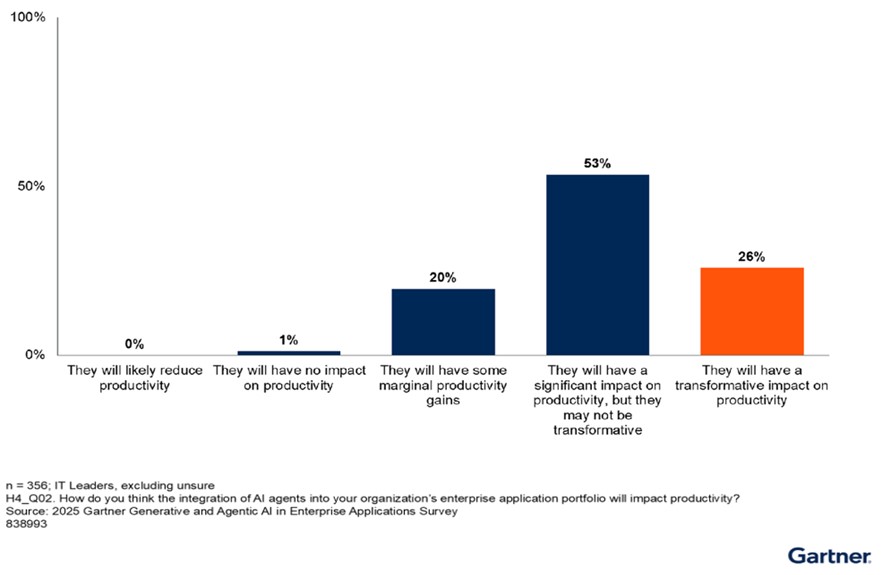
The impact of AI agents is significant, but perhaps not transformative.
Twenty-six percent of respondents considered that the agents will have a transformative impact on productivity. Most (53%) considered that the impact would be significant, but perhaps not transformative, and 20% considered that it would provide small gains.
AI agents' expectations regarding productivity.
Source: Gartner (September 2025)
The research showed that only 14% of respondents strongly agreed that there is alignment between IT, business users, and leadership on what problems AI will solve. Those who agree are 1.6 times more likely to say that AI agents will be transformative and more than three times more likely to find significant value in their tools. GenAI.
“Alignment between IT, business, and executive leadership on what problems AI can solve and how to measure its value is fundamental to successful Artificial Intelligence implementations, but we see that many organizations lack this,” says Goss.
Organizations may be focusing their AI agent implementations in the wrong places.
Organizations that lack a shared understanding of which business problems AI can solve are almost twice as likely to list office productivity as a domain where AI agents will have the greatest impact. Those with stronger alignment tend to focus on more vertical use cases, such as customer service, ERP, sales, and others.
“"Productivity in the office and the digital workspace ”They are the standard for organizations that don’t have a solid understanding of what they’re doing with agents, but they aren’t necessarily the areas that will provide the most value to organizations,“ says Goss. ”Among all survey participants, analytics and business intelligence topped the list, with 64% ranking them among the top three domains that will be most impacted by AI agents, followed by customer service (55%) and office productivity (39%).”
It is unlikely that AI agents will replace applications and workers, at least not yet.
Although the long-term implementation of AI agents is less clear, most leaders do not expect them to replace applications or workers in the next two to four years; only 12% strongly agreed that AI agents would replace applications, and only 7% strongly agreed that they would replace workers in that period.
The percentages are much higher among those who partially agreed with the statement: 341% believe that AI agents will replace applications, and 291% think they will replace workers in the next two to four years.
“This is still significant for a technology that has only been generally available for 12 months. This points to both the hype and the fear that exists around Artificial Intelligence, specifically agentic AI,” says Goss.
Gartner analysts recommend that organizations focus on three key areas when preparing to implement agency AI:
– AI agent governance: Develop a platform-agnostic AI agent governance framework that reduces the risks of dispersion and provides clear guidelines, policies, and controls to help the organization safely develop its agent capabilities across various tools and domains.
– Direct AI agents to high-impact domains: Establishing alignment between IT and business on which problems AI agents can solve is fundamental to success. For example, if implementing agents in office productivity suites presents excessive risks and offers too little return, consider other domains that could provide a more tangible ROI, such as customer service or data and analytics. Targeting AI agents to the right use cases will help build trust in the technology and show where it can have the greatest impact.
– Adopt a multi-vendor strategy for AI agents: Gartner states that it is too early to rely on a single vendor for an AI agent strategy. Organizations should explore options across ERP, CRM, and digital workplace portfolios and leverage the capabilities of vendors that meet their evolving needs.
Gartner customers can read more at “Assessing the Impact of Generative AI and Agentic AI In Enterprise Applications”.
About Gartner AI Use Case Insights
Gartner AI Use Case Insights is an interactive tool that helps technology and business leaders efficiently discover, evaluate, and prioritize potential AI use cases. Clients can search over 500 use cases (AI applications in specific industries) and over 380 case studies (real-world examples) based on industry, business function, and Gartner's assessment of business value. Clients can access the interactive tool at https://tools.gartner.com/use-case-insights.
About Gartner for Information Technology Executives
O Gartner for Information Technology Executives provides actionable, objective insights for CIOs and IT leaders, helping them lead their organizations through digital transformation and drive business growth. For more information, visit: www.gartner.com/en/information-technology. Follow the news and updates of Gartner for Information Technology Executives at the X and in LinkedIn using #GartnerIT.
About Gartner
O Gartner, Inc. delivers objective, actionable insights that drive smarter decisions and better performance for enterprises’ mission-critical priorities. To learn more, visit www.gartner.com.