



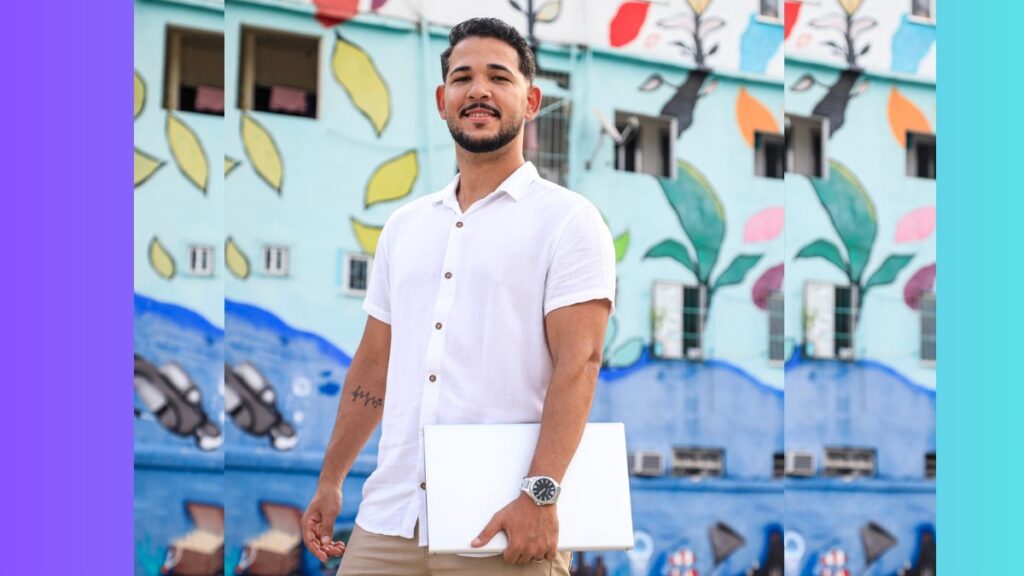
Lamonier Barbosa was working at a gym in Rio de Janeiro when he heard about a training opportunity in artificial intelligence (AI).
The AI bootcamp, offered for free by Microsoft, promised to deepen what Lamonier had already learned fixing broken computer parts before the COVID pandemic paralyzed the global economy a few years ago.
Lamonier's life during the pandemic was difficult. His mother passed away from cancer, and the lockdowns forced him to cope with his grief in isolation while struggling to pay the rent. "It was a very complicated time," he recalls.
As soon as pandemic restrictions were lifted, Lamonier enrolled in programming courses offered by a popular technology education platform and later joined Microsoft's AI training program. "I always had this desire to learn and spent a lot of time studying," says Lamonier Barbosa, "so I thought: this is a great opportunity."“
Today, Lamonier is interning at a multinational technology consulting firm that helps large companies use AI to build smarter and more efficient business systems. "Through the AI training program, my life has been transformed—completely," he says, smiling.
Lamonier is one of the 2.5 million Brazilians who took advantage of the opportunity to learn how to use AI through a new Microsoft initiative, announced in September 2024, called ConectAI.
Working in collaboration with the Brazilian government and 26 official partner organizations, ConectAI aims to support the development of skills so that 5 million Brazilians know how to use AI by the end of 2027, and has already trained half of that total. As part of the initiative, Microsoft also... is investing 14.7 billion reais over three years. in cloud infrastructure and AI in Brazil. The effort builds on previous training initiatives that Microsoft has offered in Brazil since 2020. Since then, the programs have trained 5.3 million Brazilians in digital skills, including AI.
ConectAI offers free online courses through LinkedIn Learning and partner platforms, covering everything from AI fluency and digital literacy to more advanced technical skills. It also seeks to leverage the Brazilian government's ongoing investments in digital and AI infrastructure to support economic and job growth, expand access to quality education, and ensure Brazilians have the skills needed to compete for the jobs of the future.
Today, more than 93.61% of Brazilian households have internet access, according to... Brazilian Institute of Geography and Statistics (IBGE). And Brazil has more mobile phone lines than people, with many Brazilians owning at least two cell phones, one for work and another for personal use. According to the National Telecommunications Agency (Anatel), The country has 268.6 million mobile phone lines for a population of 213 million.
But a digital divide still exists for people living in low-income neighborhoods and communities, like Vivian Vasconcelos, a resident of Maracanaú, in Ceará. “Nowadays, children are born interacting with technology, but I only started having contact with it at age 14,” she says. “So, I developed a desire to learn so as not to fall behind, especially because it’s an essential tool both in the job market and in education.”
“My plan as a child was to go to law school and become a criminal defense lawyer, and eventually, a police chief, judge, and prosecutor,” says Vivian, who is a descendant of the Pitaguary and Tapeba indigenous peoples.

After studying logistics at a technical high school, Vivian discovered that she could take free courses in customer service, basic computer skills, and app development through a program created by... Trust for the Americas and sponsored by ConectAI, which promotes digital and AI skills. Vivian didn't have a computer at home, so she walked 40 minutes, four times a week, to a building equipped with computers for students and job seekers, located in a neighboring city.
Later, her mother mentioned a Microsoft course that taught about the latest developments in AI and the chance to work with a mentor. What Vivian learned from her Microsoft mentor is something she will carry with her "for the rest of her life," she says.
The experience “was really about expanding and deepening my knowledge of AI,” explains Vivian. “It also served as an incentive to learn more… I kept wondering: ‘My God, will I ever be able to do this? Develop an app like this?’ I really like details, so the more someone explains in depth, the more curious I become… and want to develop something on my own.”
Without easy access to books, Vivian says she values the opportunity to learn through AI assistants and the internet. Her new AI skills have helped her make the most of her new job at a local textile factory, where she hopes to join the IT department. But she hasn't given up on her dream of studying law. "When you have a goal, age doesn't matter," she says. "What matters is the achievement."“
For Julia Ribeiro, the achievement was a way to overcome a difficult beginning and embark on a new and exciting path that she never imagined when she was little.
“"When I was younger, I thought I would be a doctor," says Ribeiro, "but then everything changed."”
Julia lives in Ribeirão Preto, in the state of São Paulo. The region plays a central role in Brazil's agricultural economy and is known for its coffee cultivation. Fortunately for Julia, it is also a bustling educational hub.
In the middle of high school, when she was 14, Julia's parents divorced. When her father left home, he emptied all the family's bank accounts, and her mother's job as a cleaner barely covered basic expenses. She entered... National Industrial Training Service (SENAI) He started as a young apprentice through a construction company and began technical studies in administration.
Julia dedicated herself to her studies and decided to take introductory courses in machine learning. "I had no other option but to work very hard," she says.
To help support herself and her mother, "I signed up for everything I could," she recalls. Her determination paid off when she landed an apprenticeship as a service desk analyst at a large educational group that manages schools throughout Latin America and the world. "The machine learning course helped me understand a little more about the world I was about to enter," she emphasizes.
After completing high school, Julia Ribeiro enrolled in the Microsoft AI-900 and AZ-900 courses — introductory certifications that provide essential knowledge in artificial intelligence and cloud computing — while attending a technical and vocational school in the SENAI network.
SENAI partners with industry to ensure that student education is aligned with market needs and is a long-time partner of the ConectAI initiative. Through SENAI, Julia learned about a free Microsoft AI and cloud computing course. She took advantage of the opportunity, dedicating 10 hours every Saturday for 8 weeks to learning about AI and cloud computing.
Although she is still a university student, Julia recently landed a coveted job as an infrastructure and cloud analyst at the same educational group—earning 10 times more than her mother earned as a cleaner. “Someone trusts me,” she says, smiling.
The student credits Microsoft courses, especially the classes on Azure, the company's cloud platform, with her landing her job as a cloud analyst, where she solves problems and uses AI to write code. "All these courses helped me find solutions to help the group develop this technology and make it secure," says Julia. She was also chosen to be one of Microsoft's Learning Ambassadors, helping her colleagues learn about AI and use it to increase productivity.
Today, Julia earns enough to pay for her mother's studies to become a nurse. "Now she can work doing what she always dreamed of," she says.
What she likes most about technology is the fact that it's constantly changing, providing new opportunities to learn and grow. "It never gets old, and it's good to keep up," she observes. After completing her studies in cloud engineering, she intends to study software development.
But “I’m already in my dream job,” he says, “and I achieved it at an age I never imagined.”
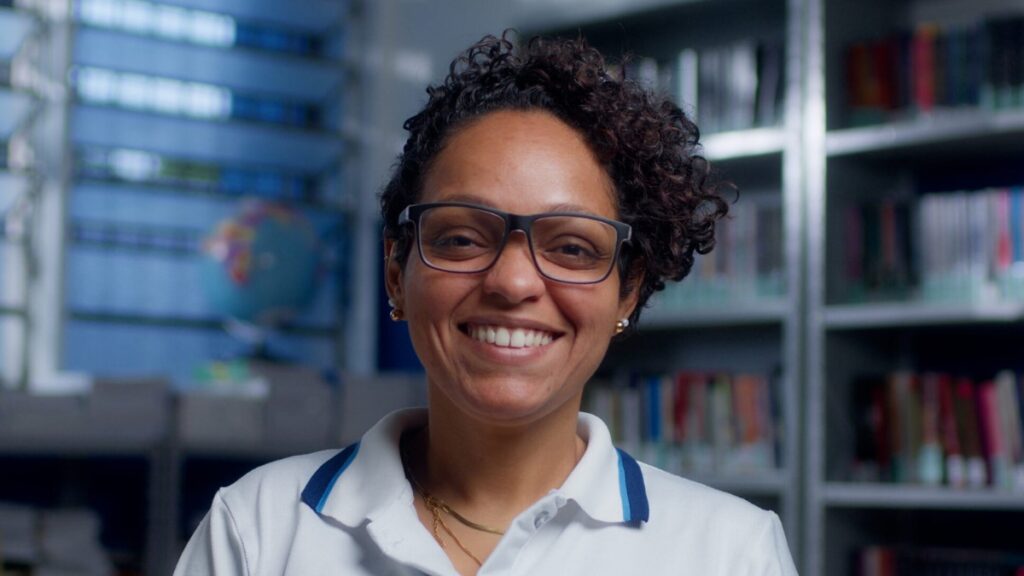
Inspiring students to envision a future beyond what they imagined is a passion for Virgínia Chagas. This is part of what led her to pursue a career as a teacher. A longtime technology enthusiast, she is a proponent of using technology to help students learn and grow.
Recently, after a discussion among students at school, Virginia suggested to the class the use of AI to create posters with messages of respect and unity, showing that technology can be a bridge to empathy and dialogue.
Currently working in the public education system of Rio de Janeiro, Virgínia has had to shift her focus to managing a large volume of daily administrative tasks. The teacher participates in initiatives that bring schools, teachers, and the Municipal Department of Education closer together, collaborating on pedagogical projects, teacher training, and supporting school teams.
According to Municipal Department of Education, Approximately 65,000 students are enrolled in the 9th grade in about 140 early childhood education schools in Virgínia's area of operation in Rio de Janeiro, along with about 4,000 teachers. Rio de Janeiro has the largest public education network in Latin America, according to... Unicef.
To continue learning and supporting other educators, she works in partnership with... New School, another non-profit organization that is part of ConectAI, including courses on AI applied to education. Nova Escola offers professional training and lesson plans aligned with the Brazilian National Curriculum Base.
With the support of AI, Virginia ensures that her department reviews and responds to hundreds of emails that arrive at regional offices every day. Each of the 185 schools in her region has its own challenges and needs, from managing lunch suppliers and maintaining infrastructure to integrating updated curricula. The emails come from various sources: students, parents, fellow administrators, and teachers.
That's why Virginia was thrilled to discover, through Microsoft's AI training, that she could connect her emails and documents to M365 Copilot, the AI assistant and companion, and ask for help. "I didn't know that was possible!" she laughs. "It's great!"“
Under her guidance, Copilot analyzes and summarizes emails, organizes deadlines, and drafts possible responses for her review. She also uses AI to help document the work done in serving students with disabilities.
“This is a department with a high level of responsibility. We make a point of carefully reviewing everything, keeping drafts, and conducting detailed checks before anything is finalized,” says Virgínia. “The AI tool is a great help.”
Virginia encourages the teachers at her school to access free AI training to help them with lesson planning, grading tests, communicating with administration and parents, and to free up more time to work directly with students.
She believes that AI tools, such as Copilot, don't replace teachers, but help them optimize their time, plan more efficiently, and free up time for what only humans can do: teach with meaning, presence, and care. Virginia argues that teachers don't need to do more, but rather have better conditions to succeed.
“Teachers are sometimes tired, scared, and overworked,” she observes. “I’ve been in their shoes. That was my role. But we must always be open to discovery, to understanding, and the school needs to evolve along with society.”
About Microsoft
Microsoft (Nasdaq “MSFT” @microsoft) creates AI-powered platforms and tools to deliver innovative solutions that meet customers' evolving needs. The technology company is committed to making AI widely available and responsibly, with a mission to empower every person and every organization on the planet to achieve more. Having operated in Brazil for 36 years, the company launched the Microsoft Mais Brasil Plan in 2020 and has since significantly expanded its investments in cloud infrastructure and artificial intelligence, in addition to leading initiatives such as the ConectAI program, which aims to train 5 million Brazilians in AI skills by 2027.
Check out the latest Microsoft news on Source Latam Brazil