



 Photo: Nicola Labate/BNDES
- Resources were secured following a decision by the National Monetary Council that extended the limit for the use of FAT (Workers' Assistance Fund) resources to support innovation in 2026.
The president of the National Bank for Economic and Social Development (BNDES), Aloizio Mercadante, announced on Friday, the 27th, R$ 10 billion in two credit lines from the BNDES Mais Inovação program, within the scope of the New Industry Brazil (NIB), to finance the diffusion of machinery and equipment for industry 4.0 and for capital goods aimed at green economy projects.
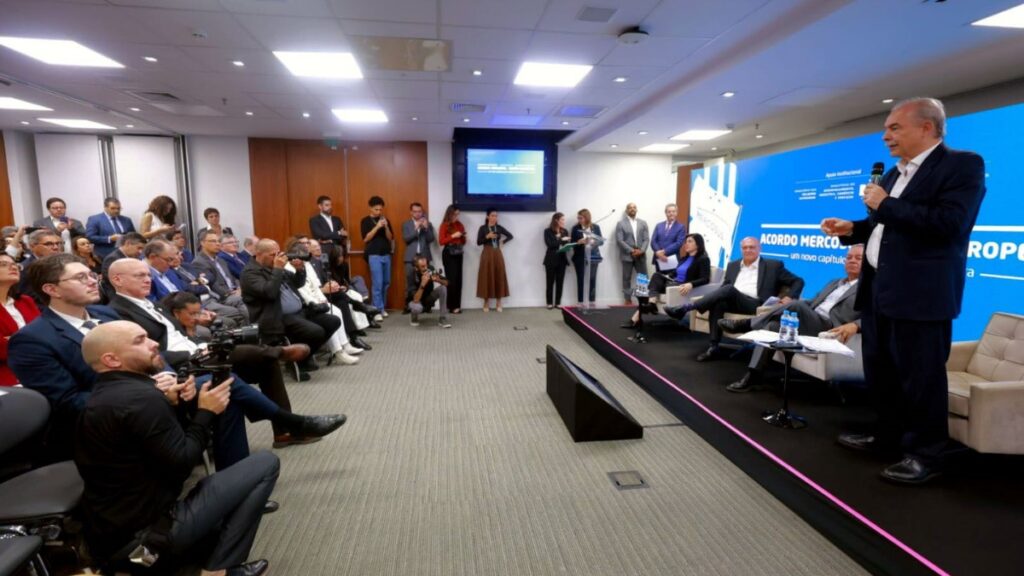
The announcement took place during the seminar “Mercosur-European Union Agreement: a new chapter for Brazilian industry”, held by the National Confederation of Industry (CNI), in São Paulo (SP), where the president of BNDES participated in a panel alongside the vice-president and minister of Development, Industry, Trade and Services, Geraldo Alckmin, the minister of Planning and Budget, Simone Tebet, and the president of CNI, Ricardo Alban.
The resources were secured after the decision of the National Monetary Council (CMN), which approved, last Thursday (26), the increase in the limit for the use of resources from the Workers' Support Fund (FAT), indexed to the Reference Rate (TR), intended for financing innovation and digitalization through BNDES. The CMN increased the maximum percentage of FAT use in innovation from 1.5% to 2.5%.
The Industry 4.0 line of credit will have a budget of R$ 7 billion and an average annual rate of 6.5%, resulting from a mix of the TR (Reference Rate) with market resources. The line of credit for green capital goods will also have R$ 3 billion, with a rate of 6.5%, from a combination of resources from the FAT (Workers' Assistance Fund) and the Climate Fund.
“BNDES is supporting innovation and digitalization in Brazilian industry,” Mercadante emphasized. “These are fundamental credit lines for modernizing the country's manufacturing base and, consequently, generating increased productivity and expanding the industry's competitiveness. President Lula's government is working to position national industry in the economy of the future, with artificial intelligence, connectivity, data analysis, and, above all, generating qualified jobs in Brazil.”.
Alckmin celebrated the achievement of the Mercosur-European Union agreement. “It is a great joy to be here together, celebrating an agreement that took a quarter of a century, but which will be implemented soon, coming into effect on May 1st,” he stated. The Vice-President of the Republic also praised the tax reform. “A study by Ipea shows that tax reform over 15 years can increase GDP by 121%, investments by 14%, and exports by 17%,” he said. “We will create much greater competitiveness and an even more export-oriented industry. Without the BNDES, all these exports would not occur. Pre-shipment credit, post-shipment credit, so that we can export more.”.
According to Minister Tebet, the national industry is entering a new phase. “For the first time, with tax reform, the New Industry Brazil program, and the European Union-Mercosur agreement, we have the conditions to ensure that Brazilian industry has a GDP share comparable to that of OECD countries and major world nations,” she assessed. “Without a strong industry, there are no jobs, no income, no reduction in social inequality, and no conditions to guarantee dignity and solidarity for the population.” Tebet also emphasized the role of the BNDES (Brazilian Development Bank) in the country's reindustrialization. “The BNDES is our bank, the development bank of Brazil,” she stated.