



91% of non-executive directors see Artificial Intelligence as an opportunity to generate shareholder value
According to new research from Gartner, Inc.., 80% of non-executive directors (NEDs) believe that current board practices and structures are inadequate to effectively oversee artificial intelligence (AI). However, 91% of these board members view AI as an opportunity to create shareholder value, rather than a risk.
“Boards of Directors are remarkably optimistic about the value potential of Artificial Intelligence, even more than CEOs (Chief Executive Officers), CIOs (Chief Information Officers) and other executives, as compared with Gartner studies,” says Daniel Sanchez Reina, Vice President and Analyst at Gartner. “However, most boards recognize that they are not well-prepared to oversee AI, as most members are not digital natives and lack technology backgrounds. Until recently, technology topics rarely occupied significant time on board agendas. But cyber risk and AI are changing that, and non-executive directors are moving quickly to increase their technology expertise and find new ways to oversee it.”
The 2025 Gartner Board of Directors Survey was conducted from June to August 2024 with 328 respondents from North America, Latin America, Europe and Asia-Pacific, all of whom hold board positions at private or public companies.
Cyber risks are universally perceived as a threat to shareholder value:
Boards of directors also demonstrate strong consensus on cyber risks, with 93% viewing them as a threat to shareholder value. They also express similar concerns about the ability of boards to oversee rapidly evolving cyber threats, with 67% rating current board practices and structures as inadequate to address cyber risks. “NEDs almost unanimously acknowledge cyber risks and express concerns about current board practices to provide effective oversight. However, the majority of NEDs (58%) express interest in taking on more technology risk, rather than less,” said Tina Nunno, vice president and senior analyst at Gartner.
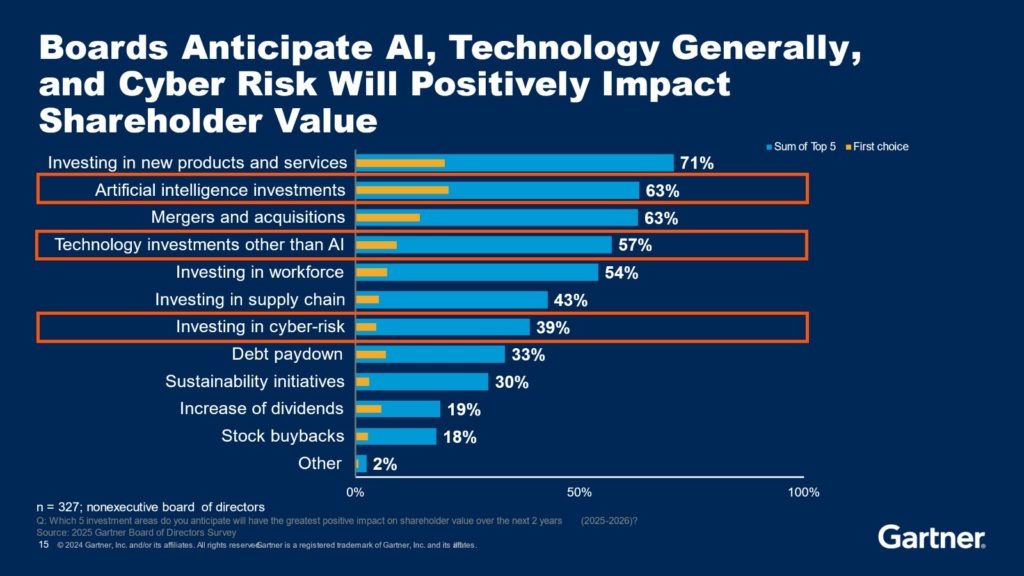
Boards advocate technology investments to drive shareholder value: Non-executive directors’ interest in AI, cyber risk and technology more broadly is also reflected in investments. When asked to name the top five investments that would drive greater shareholder value over the next two years, AI was the top overall choice, featuring in the top five of 63% respondents. Technologies other than AI featured in the top five of 57% respondents, and cyber risk investments for 39%.
Key investments for shareholder value over the next two years
 Source: Gartner (November 2024)
“Boards of directors are already beyond curious about AI and are now actively engaging their CEOs and management teams to understand the opportunities to use AI to deliver efficiencies and generate new revenue opportunities,” says Nunno.
To address technology opportunities and gaps in current oversight structures, boards plan to recruit more non-executive directors and CEOs with expertise in technology and cyber risk. The survey indicates that 77% of board members said they will need to appoint more directors with technology experience in the next 12 months. In addition, 72% said they will need to recruit more directors with cyber risk expertise, while 53% believe that the technology expertise of the next CEO will be a significant factor in succession planning.
“The willingness of directors to make structural changes to their boards and adjust the profile of CEO recruitment indicates that they believe that technology will be a critical factor in generating shareholder value in the future,” says Nunno. According to him, by 2025, NEDs will seek guidance from CIOs and CISOs (Chief Information Security Officers) to understand the opportunities and risks for their industries and companies. However, it may be necessary to adjust the way these professionals communicate with boards.
“The NEDs interviewed expressed a strong preference for communications provided by their CEOs and CFOs, which are often heavily financial in nature and directly tied to financial statements,” explains Nunno. “Wherever possible, CIOs and CISOs should focus on communicating financial impacts and risks to increase the effectiveness of their messaging.”
About Gartner for Information Technology Executives
Gartner for Information Technology Executives provides insights and objectives for CIOs and IT leaders to help them lead their organizations through digital transformation and drive business growth. Visit: www.gartner.com/en/information-technology.
About Gartner
O Gartner, Inc.. provides objective, actionable insights that drive smarter decisions and better performance for enterprises’ mission-critical priorities. To learn more, visit www.gartner.com or follow Gartner news and updates for IT executives using #GartnerIT.