



The LICA application meets the management needs of care teams, monitors care provided and provides greater security for patients' families.
Today, the welfare economy move around 5.5 trillion dollars worldwide and, in Brazil alone, the sector's turnover is in the order of 96 billion dollars, equivalent today to almost 500 billion reais. According to the latest Census According to the IBGE, the number of elderly people in the country has grown by 57.4% in the last 12 years, which confirms the growing inversion of the age pyramid, where it is expected that in the coming decades the elderly population will be much larger than that of young people and adults. In this context, society is beginning to prepare itself to meet the specific needs of this population. This is the case of Digit, a pioneering company in the development of technology solutions, which, upon completing 47 years of foundation, is advancing into the health segment with the launch of LICA, management software for monitoring the work of caregivers for the elderly and bedridden patients. The social context, combined with the personal experience of a company executive in monitoring care provided to family members, was the impetus for developing a platform aimed at managers and administrators of care companies, professional caregivers, coordinators of Long-Term Care Facilities for the Elderly (LTCFs), healthcare professionals and family members of patients. The new technology promises to deliver relevant clinical information, improves the organization of patients' routines and provides greater peace of mind and security for family members, who can remotely monitor the care provided.
Technology to anticipate patterns
Through advanced features that monitor patients' vital signs and notify caregivers of the need for immediate support, LICA can be integrated with existing monitoring devices on the market, such as smartwatches, smartbands, cameras and sleep analyzers, which are placed under the mattress to monitor heart rate and respiratory rate and send alerts to caregivers when the patient gets out of bed. The platform collects and analyzes data continuously, automatically and accessibly. 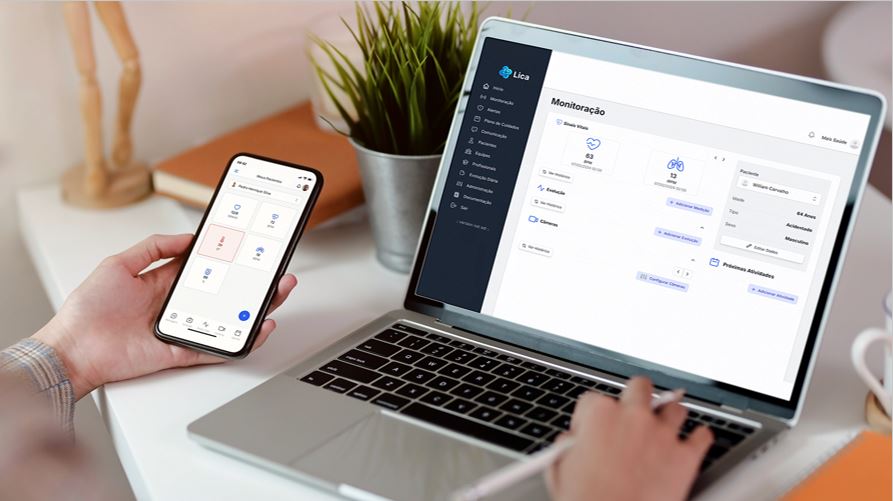
For Márcio Souza, Dígitro’s Technology Director, the solution’s innovation lies in its built-in intelligence, which integrates signal monitoring, care planning and video monitoring into a single solution. “There are technologies on the market that only offer part of these services. At LICA, we deliver everything in a single solution, hence the gain in efficiency and safety,” says Márcio.
Doctor Marcello Herdt, a specialist in Preventive Medicine and Health Management, monitored and contributed to the development of the platform and highlights the relevance of the solution for organizing patients’ routines and improving the efficiency of services provided. “With LICA, family members can monitor the care their loved one is receiving, the patient’s needs are met, and the caregiver also has the security of knowing that they have a repository of the work performed,” explains Herdt.
Safety and efficiency in elderly care
In addition to benefiting patients and their families, the solution also promises to be an ally for companies that manage care services or managers of LTCFs. The platform offers monitoring and management tools that allow detailed recording of the actions performed, increasing the credibility of the service provided and providing peace of mind to families, who can monitor their patients from anywhere in the world.
According to Octavio Carradore, Dígitro’s Director of Market Relations, LICA is more than a monitoring tool, but a resource that transforms the way elderly and bedridden patients are cared for. “By launching LICA, Dígitro is offering a solution that meets the needs of an aging population that demands increasingly specialized care,” he emphasizes.
The solution will be sold through licenses per patient, without limiting the number of users for each life served. In other words, with a person being monitored, the group of caregivers, the company that manages the services and the family members responsible can receive and interact with the information organized in the application.