



This Monday (10/6), ministers Bruno Dantas, Antonio Anastasia and Benjamin Zymler participated in a FVG Justiça roundtable on the New Tenders and Contracts Law
This Monday (10/6), the president of the Federal Court of Auditors (TCU), minister Bruno Dantas, and ministers Antonio Anastasia and Benjamin Zymler participated in a debate on the New Bidding and Contracts Law. A Round table on the New Institutes of Law 14,133/2021 was carried out in Rio de Janeiro by FGV Justiça, an arm of Fundação Getulio Vargas focused on academic research, studies and discussions to improve the justice system.
One of the points addressed by President Bruno Dantas was the transformation of external control, moving from a bureaucratic approach to practices more focused on economy, efficiency and effectiveness. The new stance of the TCU and other control bodies becomes more pedagogical, in order to promote practical solutions and ethical and efficient public management.
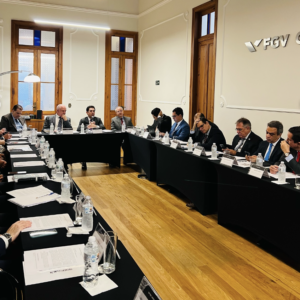
Credits: @fgv.justica
“The New Bidding Law provides mechanisms for us to institutionally try to solve the blackout of the pens, or the infantilization of the public manager, which is the situation in which the public manager prefers not to act, not take or postpone decisions, out of 'fear' due to the performance hypertrophied control organs”, observed Dantas.
The minister highlighted that the educational approach seeks transform the role of control institutions into agents that facilitate efficient and ethical public management. “Instead of being limited to a punitive function, we have invested in disseminating knowledge and building a culture of consensualism, responsibility and transparency.”
At the Court of Auditors, the creation of the Secretariat for External Control of Consensual Resolution and Conflict Prevention (SecexConsenso) seeks bring the manager closer to the administrator institutionally. “With a focus on education and prevention, we are creating an environment where correct incentives occur so that public resources are used efficiently and for the benefit of all”, stated the president.
Competitive Dialogue
The minister also spoke about the competitive dialogue introduced by the new legislation. Inspired by international good practices, the modality seeks to improve interaction and flexibility in public procurement, promoting greater collaboration between the public sector and suppliers.
In this case, the public administration carries out dialogues with previously selected bidders, with the aim of developing one or more alternatives capable of meeting your needs. After the dialogues, bidders present their proposals.
Dantas highlighted that competitive dialogue is indicated for situations in which the public entity wants contract more technical, more personalized or less conventional services or products, that may not even exist on the market yet. “It is a strategic process to meet the specific needs of the contracting body, which allows, based on interaction between the public and private, customized solutions to emerge for each situation”, defended the minister.