



New data shows that the majority of employees are experimenting with AI and developing their skills – now it’s every leader’s job to channel this experimentation into business impact
Recently, Microsoft and LinkedIn released the 2024 edition of the joint “Job Trends Index” report. With the title "AI has already arrived at work. Now comes the difficult part,” research shows how, in just one year, Artificial Intelligence is influencing the way people work, lead and hire around the world. Along with the study, Microsoft announced new features in Copilot for Microsoft 365, and LinkedIn made more than 50 free learning courses available to LinkedIn Premium subscribers, designed to empower professionals of all levels to advance their AI skills.
The data shows: 2024 is the year when the use of AI at work becomes real. Over the past six months, the adoption of generative AI at work has nearly doubled. LinkedIn is seeing a significant increase in professionals adding AI skills to their profiles and most leaders say they wouldn't hire someone without AI skills. However, many leaders worry about their company not having an AI vision and about employees using their own AI tools at work. At this point, they are faced with a challenge of any technological disruption: moving from experimentation to tangible business impact.
“AI is democratizing experience across the entire workforce,” said Satya Nadella, President and CEO of Microsoft. “Our latest research highlights the opportunity for all organizations to apply this technology to drive more assertive decision-making, collaboration and, ultimately, business results”, ends.
The Work Trends Index was based on a survey of more than 31 thousand people in 31 countries, including Brazil; labor and hiring trends on LinkedIn, trillions of anonymous productivity signals from Microsoft 365, and surveys of Fortune 500 customers. The report highlights three insights every leader and professional needs to know about the impact of AI on work and the job market in the next year:
People want AI at work – and they won't wait for companies to catch up: 75% of the world's intellectual workers are already using AI at work, in Brazil this percentage is 83%. Employees, many of whom struggle to keep up with the pace and volume of work, say AI helps them save time, stimulate creativity and allow them to focus on more relevant activities. But while 79% of global leaders – and 87% of Brazilian leaders – agree that adopting AI is crucial to remaining competitive, 59% are concerned with quantifying AI's productivity gains and 60% say their companies lack a vision and plan. technology implementation. In Brazil, this statement applies to 51%.
The pressure to show immediate ROI is making leaders reticent, even in the face of the inevitability of AI. The consequence is that employees are taking their own initiatives to use AI. In Brazil, 74% of AI users say they bring their own tools to work, compared to 78% for the global average, – Bring Your Own AI to Work” (BYOAI) – and it is causing companies to lose benefits of strategic use of AI at scale and putting company data at risk. The opportunity for all leaders is to bridge this AI moment with ROI.
For employees, AI expands career opportunities: Although the relationship between the use of AI and job losses is a priority topic for many, the survey data reveals new nuances of perspective – such as a hidden talent shortage, employees looking for career changes, and massive opportunities for those who are willing to train in AI. Most global leaders (55%) are concerned about having enough talent to fill positions in cybersecurity, engineering, and especially creative design this year. And professionals are looking. Around 46% of the world's people are considering quitting next year, the highest number since the “Great Reshuffle of 2021”. A parallel study by LinkedIn shows that in the USA this number could be even higher with 85% of respondents wanting to change careers. While two-thirds of leaders (66%) globally and 58% in Brazil would not hire someone without AI skills, only 39% of users have received AI training from their employers and only 25% of companies expect to offer it this year.
So, professionals are improving on their own. At the end of last year, we saw a 142x global increase in the number of LinkedIn members adding AI skills like Copilot and ChatGPT to their profiles and a 160% increase in the number of non-technical professionals using LinkedIn Learning courses to develop their skills in AI. Another trend observed is that mentions of AI in LinkedIn job postings generate a 17% increase in application growth, attracting more talent. It's a two-way street: organizations that empower employees with AI and training tools will attract the best talent, and professionals who train themselves will have advantages in hiring processes.
The rise of AI experts – and what they reveal about the future: Four types of AI users emerged in the research – from skeptics, who rarely use AI, to advanced users (or experts), who use it extensively. Compared to the skeptics, the most advanced users of AI refocus their workdays in fundamental ways, reimagining business processes and saving more than 30 minutes a day. More than 90% of AI experts say they are managing their workload better, making their everyday lives more enjoyable, but they are not doing it on their own. These users are 61% more likely to hear from their CEO about the importance of using generative AI at work – in Brazil this percentage is higher than 75% -; 53% of these power users are also more likely to receive encouragement from leadership to consider how AI can transform their role and 35% more likely to receive AI training tailored specifically to their role.
“AI is redefining work, and it’s clear we need new playbooks,” said Ryan Roslansky, CEO of LinkedIn. “It is leaders who build for agility rather than stability and invest in building capabilities internally that will give their organizations a competitive advantage and create more efficient, committed and equitable teams.”
Microsoft also announces new features in Copilot for Microsoft 365 to help people get started with AI
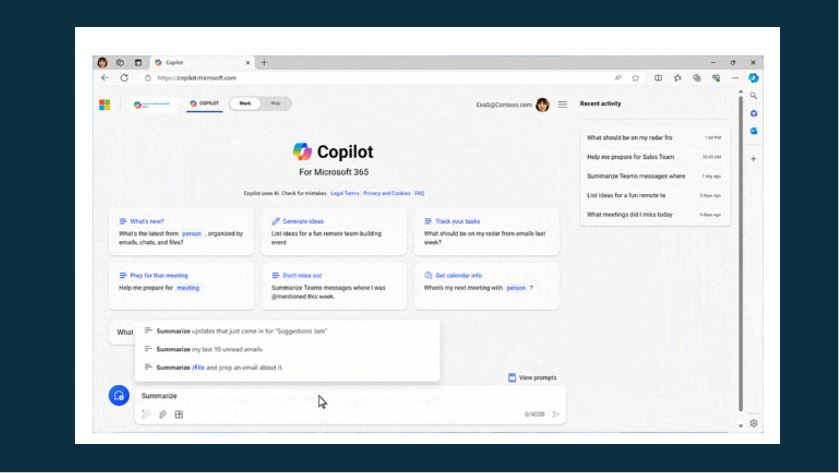
- A new feature automatic filling is coming to the prompt box. Copilot will now help people who started a prompt by offering to complete it with a more detailed command based on what is being typed, thus providing a stronger result.
- When people know what they want but don't have the right words, the new rewrite from Copilot will turn a basic prompt into a rich prompt with the click of a button.
- already the Catch Up Update is a new chat interface that presents personal insights based on recent activity and provides responsive recommendations. For example, Copilot will flag an upcoming meeting and provide relevant information to help attendees prepare.
- And new Copilot Lab features will allow people to create, publish, and manage prompts customized for themselves and their specific team and role.
LinkedIn is now providing AI tools to enable you to stay ahead in your career:
- To improve skills. LinkedIn Learning offers over 22,000 courses, including over 600 AI courses, to develop aptitude in generative AI, empower your teams to make business investments powered by Gen AI or simply to keep your skills up to date. This includes more than 50 new AI learning courses to empower professionals at all skill levels. The new courses are available free of charge to everyone until July 8th. Plus, our new AI-powered training on LinkedIn Learning helps learners find the content they need to build their skills with faster, greater personalization, and guided conversational learning.
- To advance your career. For LinkedIn Premium subscribers, AI-generated personalized findings in the LinkedIn feed on posts, articles, or videos (from article to comment) can also help you every day in your career with personalized, relevant insights and opportunities, including ideas and actions that you can accomplish.
- To look for a job. And if you want to change jobs, we also make finding your ideal job quick and easy. With new AI-powered tools, you can now assess your suitability for a role in seconds based on your experience and skills, get advice on how to stand out, and subscribers will also see tips such as suggested skills to develop , professionals in your network to contact and more. So far, +90% of subscribers who have access to the tools say they have been helpful in their job search.
To learn more, visit the Official Microsoft Blog, the 2024 Job Trends Index Report and access LinkedIn to hear more (in English) from the company's chief economist, Karin Kimbrough.