



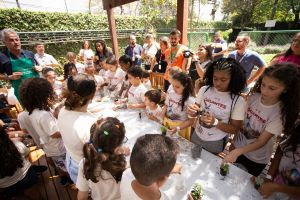
In addition to playful activities for the little ones, the ADP Kids Day seeks to work with the internal team on the importance of building more human bonds with each other
In the corporate environment, allowing employees to maintain constant contact with their children is one of the main ways to strengthen the organizational culture and retain talent. Especially after the close experience everyone had with their family during the Covid-19 pandemic.
“Keeping a team motivated and satisfied is a daily challenge. Happy employees are more productive. As we value them, we increase their sense of belonging and relevance to the business. This directly influences individual results and, consequently, those of the company”, analyzes Mariane Guerra, vice president of Human Resources at ADP for Latin America. “Therefore, the promotion of initiatives in the work environment that allow the inclusion of employees' families demonstrates this concern of managers with their team and helps to strengthen the organizational culture.”
An example of action carried out by ADP with this objective, mainly during the school vacation period, is the ADP Kids Day, a day dedicated to employees' children so that they can not only find leisure in the work environment, but also have the opportunity to get to know the employees' routine, environment and co-workers. At the event, children spend the day at the company, along with their parents, with unrestricted access to most office facilities. In addition, various recreational activities are carried out, always having as a guideline the interaction between people and the environment. “These are actions specifically designed for the younger generations, placing the human factor at the center of the initiatives, as is the ADP culture”, emphasizes the executive.
Strong organizational culture is a seal for attracting talent
The construction of a strong corporate culture, which is assimilated by all employees, is one of the main points listed by experts as contributing to companies having teams that are engaged and aligned with the companies' business strategy. This construction of a strong corporate culture is an ongoing task and, taking into account the new reality of post-pandemic work, they must adapt and provide spaces that reflect on the balance between life and routine in the personal and work scope.
A recent study carried out by the consultancy The Economist Intelligence Unit, at the request of ADP, with C-level and HR executives around the world, within the context of companies' international expansion, showed that understanding/managing cultural differences and their implications in HR is one of the main concerns of managers, being pointed out by 46% of the interviewees as a challenge.
For Mariane Guerra, with the consolidation of hybrid work – this being a trend more to be considered in the post-pandemic scenario –, the need to build a strong corporate culture will present itself, this year, as a challenge for companies of all sizes and performance profiles. The executive also points out that, despite being a challenging task, it is indeed possible for managers to carry out actions to encourage the dissemination of culture among employees, strengthening ties between company and employee, which will provide discussions and initiatives aimed at increasing levels of job retention.
In Brazil, one of these ADP Kids Day meetings took place on January 19, at the company's headquarters building, located in the city of São Paulo, and was attended by more than 330 children, adding up to an average of more than 380 family members involved in this occasion. , made up of ADP workers from Brazil and Latin America.