



IT executives should not change their investment plans because of inflation or currency volatility
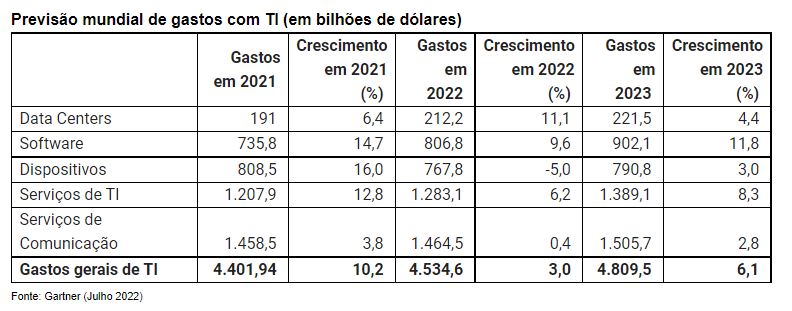
O Gartner, a world leader in business research and advice, predicts that worldwide IT spending will total US$ 4.5 trillion in 2022, which is an increase of 3% over 2021. While IT spending is expected to grow in 2022, it will at a much slower pace than last year, mainly due to consumer spending cuts on PCs, tablets and printers, causing device spending to decrease by around 5%.
"THE inflation it is a global concern. Central banks around the world are focusing on fighting inflation, with the expectation that overall inflation rates will be reduced by the end of 2023. However, the current levels of volatility seen in both inflation and exchange rates should not impede the investment plans of CIOs (Chief Executive Information) for 2022”, says John-David Lovelock, Analyst and Vice President of Research at Gartner. “Organizations that do not invest in the short term are likely to fall behind in the medium term and risk not existing in the long term.”
Price increases and uncertainties exacerbated by Russian invasion of Ukraine, have accelerated the transition in purchasing preference among CIOs and enterprises across the board from property to service – driving cloud spending to growth of 18.4% in 2021 and an expected increase of 22.1% in 2022. Cloud is not only reshaping the IT services industry, it is also driving server spending to 16.6% growth in 2022 as hyperscalers build their data centers.
Gartner forecasts data center spend to represent the strongest growth of all segments in 2022, with an 11.1% increase. Cloud consulting and implementation and cloud managed services are expected to grow 17.2% in 2022, jumping from US$ 217 billion in 2021 to US$ 255 billion in 2022, a move that will help propel IT services as a whole to growth of 6.2% in 2022.
IT Talent Gap Is Affecting IT Spending – The critical shortage of IT skills felt around the world is expected to decrease by the end of 2023, when the corporate effort to complete digital transformations wanes and there is time to re-skill and re-skill existing staff. However, in the short term, CIOs will be forced to take steps to balance increasing IT demand and decreasing IT staffing levels.
The IT job market remains tight, making it difficult to attract and retain talent. Gartner's Global Job Market Survey of nearly 18,000 employees in Q1 2022 showed that pay is the number one driver for attracting and retaining IT talent. Technology service providers are raising IT prices to enable competitive salaries. This is driving an increase in spending on software and services through 2022 and 2023. Worldwide spending on software is expected to grow by 9.6%, to US$ 806.8 billion in 2022, and global spending on IT services is expected to reach US$ 1, 3 trillion.
“Additionally, CIOs are using more IT services to help with the lack of skilled IT staff. Tasks that require smaller skill sets tend to be outsourced to managed services companies to alleviate staff time, while critical strategy work, which requires high-level skills unattainable by many organizations, will increasingly be performed by outside consultants.” , says Lovelock.