



Brazil was the participating country with the highest percentage growth in credit card and loan applications
A global survey by Experian shows that Brazilians were the ones who most started to apply for credit online during the Covid-19 pandemic. In an issue that analyzes digital behavior around the world, alternatives for credit card applications grew by 5 percentage points and that for loan applications increased by 9 pp, while in other countries there was stability or even a fall.
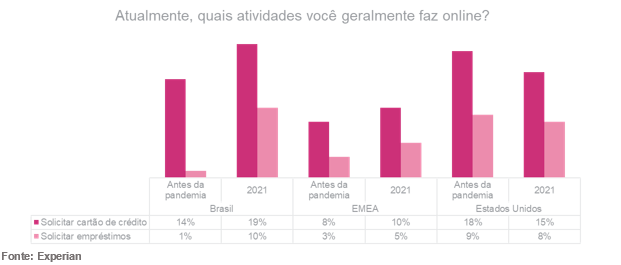
According to the director of Decision Analytics at Serasa Experian, Pedro Braga, “the pandemic has increased the already growing demand for digital self-service related to credit applications and the search for assistance in meeting financial obligations. Consumers not only want but expect to be able to apply for credit whenever and wherever they are, often using a mobile device.” For Braga, adaptation must be paramount, as the data also show that one in four consumers started to buy elsewhere because a company he was a client did not adapt to their digital needs.
Another factor that impacts the changes is the global economic scenario, with government incentives and more accessible lines of credit, which end up making companies face the challenge of identifying the real situation of consumers. That's why about half of them around the world are dedicating resources to improving their analytics capabilities. Investments in analytics, as solutions of Machine Learning, enable businesses to quickly use non-traditional datasets, explain what the data is revealing, and test new credit risk and forecasting models.
“Innovative companies will need to go beyond traditional data sources and leverage alternative and synthetic data to anticipate their customers' credit needs by using tools to automate the process and reduce risk. Good examples are initiatives such as the Positivo Register and Open Banking in Brazil, which help to improve the analysis”, comments Braga
1 in 3 consumers in the world are still concerned about finances
The pandemic has also brought about many changes in the financial profiles of consumers, who today are globally divided between those who still face concerns about their finances and others who say they have already recovered from this period of social distance. Globally, 1 in 3 people still have this concern, although the survey also indicates a drop among those who say they have reduced superfluous expenses. In Brazil, even though attention to financial problems is still higher than the global average (44%), some points indicate improvement, such as the reduction of those who use financial reserves to keep their accounts up to date.
With this difference in the economic profile, companies need to understand well their target audience and the segment in which they operate in order to better take credit risk decisions. The global report indicates three essential actions for leaders who want to do well, even in this unusual period: leverage data and analytics to gain a comprehensive understanding of risk and what opportunities the product and service portfolio offers, as well as being quick to identify changes in customer profiles to develop the best strategy; engaging customers proactively, with new credit products and conditions to assist recovery; and preparation for a possible wave of default, providing possible conditions for those still facing difficulties and avoiding greater financial losses to the business.
“Countries faced the pandemic and see its effects in different ways, with consequences for companies and consumers. That is why it is important to understand the current situation in the region, its levels of unemployment and default, in addition to the movements in the sector in which it operates, in order to develop strategies that meet different credit needs. Lenders need to understand now, more than ever, who their customers are and provide them with the right solutions at the right time”, says Pedro Braga.
Methodology
The material resulted from three studies carried out between June 2020 and January 2021. 9,000 consumers and 2,700 companies from 10 countries were interviewed: Germany, Australia, Brazil, Singapore, Spain, United States, France, India, Japan and the United Kingdom.