



The technology validates the analysis in real time, through an online connection with the existing observation network. The results were shared on March 3rd, in a workshop aimed at Colombian institutions.
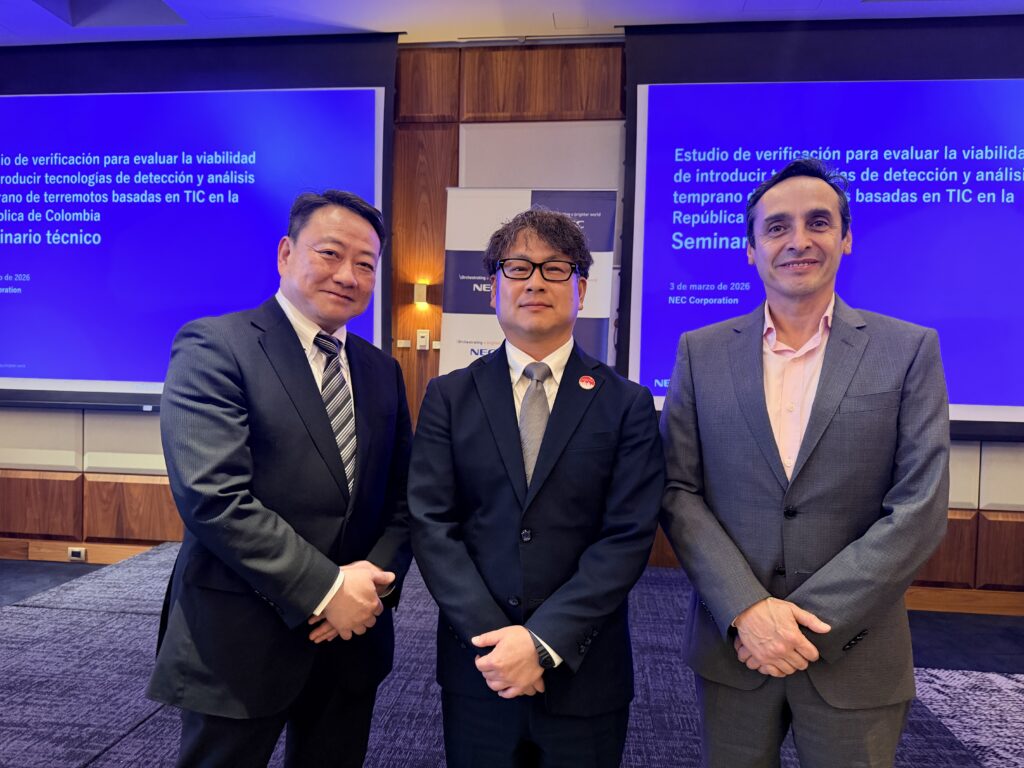 Nobuo Kiriyama, Takito Toeda and Julio Fierro Morales
NEC completed a study focused on evaluating the feasibility of implementing Earthquake Early Warning System (EEWS) Developed by the company in Colombia. The project was carried out between September 2025 and March 2026, within the framework of a public call from the Ministry of Internal Affairs and Communications of Japan.
The initiative aimed to analyze the effectiveness of this technology in the Colombian context and identify the technical, operational, and institutional challenges associated with its potential implementation, leveraging NEC's experience in developing EEWS systems in Japan.
During the work, tests were carried out using data from the existing seismic observation network in Colombia. In a preliminary phase, it was confirmed that the system allows estimating key parameters, such as epicenter and magnitude, from records of seismic events that occurred in the country. Subsequently, the EEWS was connected online to local seismographs to analyze data in real time, while its accuracy was also evaluated with historical data. In offline validation, 39 seismic events were analyzed, of which the system detected 37. The results indicated that accuracy can be increased by optimizing the location and density of observation stations and by strengthening the communications infrastructure.
On March 3rd, NEC held a workshop in Colombia to present the results, with the participation of institutions linked to seismic monitoring and risk management, including the Japanese Ministry of Internal Affairs and Communications, the Colombian Geological Survey (SGC), the National Unit for Disaster Risk Management (UNGRD), and the Ministry of Information and Communications Technologies (MINTIC). During the meeting, the technical results of the study were presented – including online and offline validations – as well as the main operational and regulatory aspects that should be considered in a possible implementation of the system in the country.
One of the study's findings was that early warning systems can complement the capabilities of current seismic monitoring mechanisms. While surveillance networks focus on accurately determining the origin and characteristics of earthquakes, EEWS allows for issuing alerts before the arrival of the most intense seismic activity, which can provide valuable seconds for taking protective measures.
“Today we are seeing very interesting possibilities for the future. First, we must define the usefulness of early warning technology and then calculate the cost of its implementation. This will allow us to better define the necessary capabilities. Early warning systems could save lives and protect property. For example, they would help prevent fires associated with residential gas systems, prevent people from getting trapped in elevators, and allow for improved risk management at large dams,” he stated. Julio Fierro Morales, Director-General of the Colombian Geological Survey.
The expert also highlighted the challenges of seismic monitoring in the country: “At the moment we have good instrumentation compared to Latin America. However, if we compare it to countries like Japan, our network is much less dense. Colombia is also a geographically very complex country, so we need to prioritize areas. We have regions with more dangerous seismicity and a history of large magnitude earthquakes.”
Colombia, like Japan, is located in the Pacific Ring of Fire (Ring of Fire), a region characterized by high seismic activity. In this context, strengthening mechanisms for rapidly transmitting seismic information to authorities and the public is a key element in improving disaster prevention and response. Based on the results obtained, NEC will continue to assess the feasibility of introducing EEWS in the country, within the framework of technological cooperation between Japan and Colombia promoted by the Japanese Ministry of Internal Affairs and Communications and the Colombian Ministry of Science, Technology and Innovation.
Second Nobuo Kiriyama, Deputy Director-General of the International Strategy Office of the Ministry of Internal Affairs and Communications of Japan (MIC), The introduction of this system will significantly contribute to strengthening the disaster risk management capacity of the Andean country. “I express my sincerest gratitude for the valuable cooperation of the Colombian Government authorities. In the area of ICT, in 2024, the Memorandum of Understanding for cooperation between the Ministry of Science, Technology and Innovation (MINTIC) and the Ministry of Industry and Commerce (MIC) was renewed, committing us to further deepening cooperation between both ministries. The project was carried out as part of this cooperation. Taking this initiative as a starting point, we wish to continue strengthening, through public-private collaboration, the cooperative relationship between the two countries,” Kiriyama highlighted.
“The initiative that led to the analysis of the solution and that brings together efforts between Colombian and Japanese authorities and NEC represents an important step for the safety of citizens and for expanding the country's response capacity. Having alerts issued a few seconds in advance can make a significant difference in protecting lives, critical infrastructure and essential services,” he stated. Takito Toeda, a professional in the New Business Development, DX Resilience, and DX Infrastructure Business Division at NEC.
About NEC Corporation
NEC Corporation has established itself as a leader in the integration of IT and network technologies, promoting the brand statement “Orchestrating a brighter world“NEC enables businesses and communities to adapt to the rapid changes occurring in both society and the marketplace by delivering the social values of safety, security, equity and efficiency to promote a more sustainable world where everyone has the chance to achieve their full potential. For more information, visit NEC at https://www.nec.com.